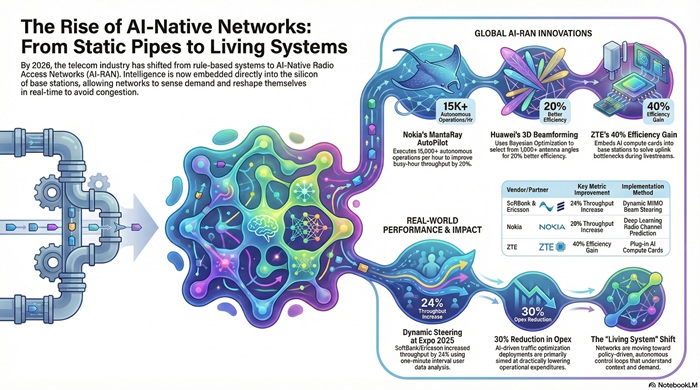
While conversational AI and customer experience dominated early headlines, 2026 has become the year the telecom industry finally fixed the “pipes” themselves. We have moved from rule-based systems to AI-Native Radio Access Networks (AI-RAN), where intelligence is embedded into the silicon of every base station.
The recent deployment by SoftBank and Ericsson across Japan’s major arenas marks a pivotal shift in managing massive traffic fluctuations. By using an external AI control system that analyzes user distribution data at one-minute intervals, they’ve moved away from static, pre-set coverage patterns. During high-demand events like the Expo 2025 in Osaka, this system delivered a 24% increase in downlink throughput (from 76.9 Mbps to 95.5 Mbps) by dynamically steering Massive MIMO beams. This isn’t just a pilot; it’s an operational standard for avoiding “packet stalling” in crowded venues.
The Global AI-RAN Landscape
The industry is currently seeing a “tsunami” of AI-driven traffic optimization deployments aimed at reducing opex by up to 30%:
# Nokia’s MantaRay AutoPilot: Deployed globally in 2024–2025, this system performs over 15,000 autonomous operations per hour. It uses deep learning to predict radio channel states, reducing overhead and improving busy-hour throughput by 29%.
# Samsung & SK Telecom: They have rolled out an AI-RAN Parameter Recommender that analyzes RAN metrics like signal-to-interference-plus-noise ratio (SINR) to tune network settings in real-time.
# Huawei’s 3D Beamforming: Utilized at massive gatherings like the Rio Carnival, their AI uses Bayesian Optimization to select the best configuration from over 1,000 possible antenna angles, boosting spectrum efficiency by 20%.
# ZTE’s AIR Engine: This approach embeds AI compute directly into base stations via “plug-in” cards to optimize uplink performance—the frequent bottleneck when crowds are livestreaming to social media—resulting in a 40% efficiency gain.
Parallel to vendor-led innovation, operators adopting Open RAN architectures are leveraging AI/ML-driven RAN Intelligent Controller (RIC) applications to optimize load balancing, mobility, and traffic steering in near real time. These deployments signal a move toward policy-driven, AI-native RAN control loops.
The common thread across all these initiatives is clear: telecom networks are evolving from static infrastructure into living systems—systems that sense demand, understand context, and reshape themselves continuously.
As traffic patterns become more volatile—driven by events, video, uplink-heavy applications, and emerging XR workloads—AI-based traffic optimization will define network competitiveness. The industry is no longer asking if AI should control network behavior, but how fast it can be trusted to do so autonomously.
The path to autonomous networks is no longer theoretical. It is already live—one beam, one cell, and one AI decision at a time.


Be First to Comment