Last updated on May 16, 2026
I am currently halfway through reading the book Only the Paranoid Survive by former Intel CEO Andrew Grove. The full title of the book is Only the Paranoid Survive: How to Exploit the Crisis Points That Challenge Every Company and Career.
The book was published in 1995, and even after more than 30 years, many of its insights still feel extremely relevant today. Over these three decades, the technology industry has gone through massive transformations — from the era of Windows 95 to the internet revolution, cloud computing, and now AI-driven systems.
We have seen organizations move their workloads and applications to the cloud. We have seen traditional monolithic applications gradually break into microservices architectures. We have seen computing power evolve rapidly, enabling new generations of software and digital experiences.
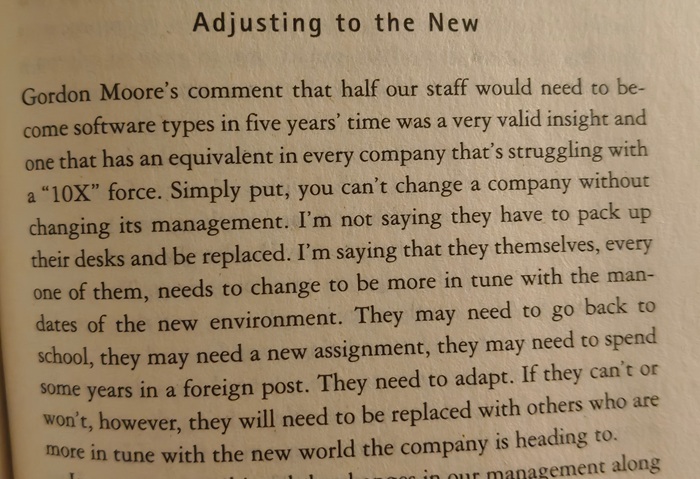
One of the interesting observations while reading this book is how accurately Intel leaders understood technological transformation. Gordon Moore predicted that chip capacity and computing power would continue to grow exponentially over time (approximately, every two years, the number of transistorstors that could fit on a chip will be doubled). Looking at the rise of AI in the last six to seven years, it feels like many of those predictions are now becoming reality.
The section that caught my attention the most talks about Intel’s own transformation journey. Intel was originally known as a memory company before becoming a dominant microprocessor company that powered the global PC ecosystem. But at one stage, Intel also started considering whether it needed to become a software-oriented company.
This meant much more than launching software products. It required organizational transformation. Senior leadership, middle management, and engineering teams all needed to learn new ways of working, understand software ecosystems, and adapt their thinking. Intel realized that surviving technological shifts required changing not only products, but also people, culture, and operations.
While reading this, I could not help comparing it with what organizations are experiencing today with AI. Almost every technology-driven company is now discussing AI agents, Generative AI, automation tools, and AI-assisted operations.
In many ways, this feels similar to the transformation Intel experienced decades ago. The technology changes, but the pattern remains the same. Organizations are forced to rethink how they operate, how employees work, and how value is delivered to customers.
Even in my own day-to-day work, I can clearly see this shift. The way I worked in 2024 and 2025 is already different from how I work in 2026 because AI tools are now becoming part of everyday operations. Used correctly, AI can significantly improve productivity, decision-making, and efficiency.
But the bigger question for organizations is not simply whether employees use AI tools. The real challenge is understanding how AI can enhance the capabilities of engineers, sales teams, marketing professionals, analysts, and decision-makers.
Companies need to identify how AI can:
- Improve employee productivity
- Enhance delivery quality
- Reduce operational effort
- Accelerate time-to-market
- Improve customer experience
- Enable employees to contribute at a higher strategic level
Technology transformations happen repeatedly every decade. But the organizations that survive are usually the ones willing to adapt their culture, operations, and people alongside technology.
That is perhaps the biggest lesson I am taking away from Only the Paranoid Survive.




Be First to Comment