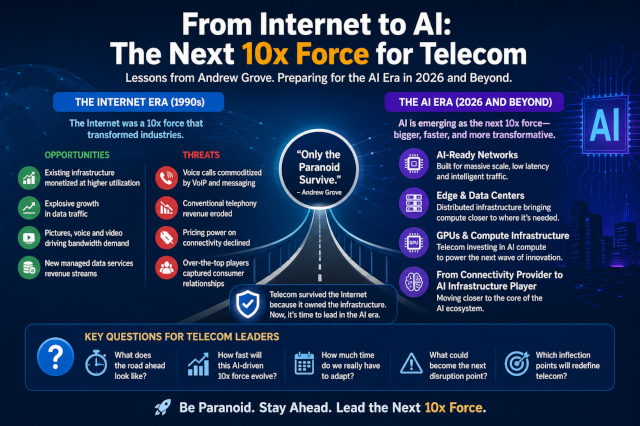
Past Intel CEO Andrew Grove’s book Only the Paranoid Survive offers countless lessons for working professionals who want to continuously evolve and stay relevant in their careers. Even though the book was published decades ago, many of its ideas feel surprisingly relevant in today’s AI-driven world.
I recently finished reading the book, but one chapter in particular stayed with me long after I completed it — the final chapter, where Andrew Grove talks about the Internet as a “10x force.”
Since my work is closely connected to the telecom and networking industry, this chapter pushed me to think beyond the Internet revolution of the 1990s and compare it with the transformation we are witnessing today with AI.
The Internet changed industries forever. It disrupted business models, accelerated digital adoption, created entirely new ecosystems, and forced companies to reinvent themselves. But while reading this chapter, one question continuously came to my mind:
Are we now entering another similar 10x force moment with AI?
Telecom operators successfully survived the Internet transformation because they already owned and operated the infrastructure required to move Internet traffic across the world. Connectivity became the backbone of the digital economy.
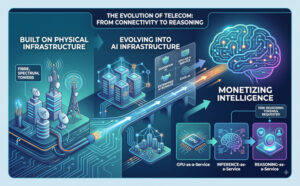
But in 2026, the telecom industry is entering a very different phase. Telecom operators are no longer just connectivity providers supporting AI applications for end users. They are gradually becoming part of the AI infrastructure itself.
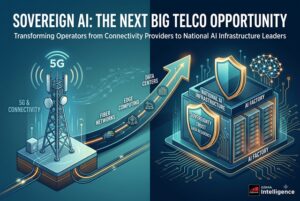
With increasing investments in AI-ready networks, edge infrastructure, GPUs, data centers, and distributed computing capabilities, telecom operators are now positioning themselves closer to the core of the AI ecosystem — an area that was traditionally dominated by hyperscalers.
This shift raises several important questions:
- What does the road ahead look like for telecom operators in the AI era?
- How fast will this new AI-driven 10x force evolve?
- How much time do telecom companies really have to innovate and adapt?
- What could become the next major disruption point in telecom?
- Which new inflection points will redefine the telecom industry over the next decade?
These are the thoughts that stayed in my mind after reading the final chapter of Only the Paranoid Survive.
Let’s dive deeper into it.
Grove’s Warning of Internet as 10x Force against AI in 2026
In the mid-1990s, Andrew Grove was preparing Intel’s strategic direction when he realized that something fundamentally different was happening in the technology industry. The Internet was not just another technology trend. It felt much bigger — perhaps the biggest shift in the business environment he had seen in years.
But Grove was not satisfied with instincts alone. He asked a far more important question:
Could the Internet become a “10x force”?
In Only the Paranoid Survive, Grove describes a 10x force as a transformation so powerful that it completely reshapes industries, business models, and competitive dynamics. Most market changes are gradual. Companies usually adapt to pricing pressure, new competitors, or product improvements over time. But a 10x force changes the rules of the game itself.
The companies that survive such moments are usually the ones that recognize the shift early and act before the disruption becomes impossible to ignore.
The Internet eventually became one of the greatest examples of a 10x force. And telecom operators found themselves directly at the center of this transformation.
The same networks that once primarily carried voice traffic were suddenly carrying Internet data — faster, cheaper, and at a scale nobody had imagined before. This shift transformed connectivity into the backbone of the digital economy and forced telecom companies to rethink their role in the technology ecosystem.
Now, in 2026, it feels like another similar moment is unfolding in front of us.
Generative AI, Agentic AI, and Physical AI are not arriving as simple feature upgrades or productivity tools. Together, they are creating a much larger structural transformation. They are redefining the kind of infrastructure networks must support, the services organizations must deliver, and even what it means to operate as a telecom company in the AI era.
And once again, the same question raised by Andrew Grove feels incredibly relevant today:
Is AI the next 10x force?
And if it is, how should organizations — especially telecom operators — prepare for what comes next?
How the Internet Changed Telecom — And How Telecom Survived
When Andrew Grove analyzed the impact of the Internet on the telecommunications industry, he explained the situation with remarkable clarity.
On one side, the Internet created a massive opportunity for telecom operators. Data traffic was expected to grow rapidly, and telecom companies already owned the critical infrastructure required to carry that traffic — telephone networks, switching systems, fiber infrastructure, and connectivity platforms.
But on the other side, the Internet also represented a major threat.
Traditional voice communication, which had once been the foundation of telecom revenues, was gradually being replaced by low-cost, packet-switched Internet data. The very technology that telecom operators enabled was also slowly commoditizing their most profitable business model.
| Category | Points |
|---|---|
| Opportunities | Existing infrastructure monetized at higher utilization |
| Explosive growth in data traffic volume | |
| Pictures, voice and video driving bandwidth demand | |
| New managed data services revenue streams | |
| Threats | Voice calls commoditized by VoIP and messaging |
| Conventional telephony revenue eroded | |
| Pricing power on connectivity declined sharply | |
| Over-the-top players captured consumer relationships |
Looking back from 1996 to 2026, the telecom industry’s story is ultimately a story of survival through adaptation. Telecom operators did not disappear. Instead, they transformed themselves.
Voice calling, once the core revenue engine of the telecom industry, eventually became just another bundled feature inside data plans. The industry shifted its focus toward bandwidth consumption, mobile internet, cloud connectivity, digital services, enterprise networking, and managed infrastructure offerings.
Companies such as AT&T, Vodafone, and Reliance Jio invested heavily in fiber networks, 4G, 5G, and digital infrastructure. Over time, telecom operators managed to convert what once looked like an existential threat into their primary business opportunity.
By 2026, most telecom operators have largely accepted their role in the Internet economy. They have become the digital pipes powering global connectivity.
But many telecom companies now want to move beyond being just connectivity providers. They aspire to become digital platforms, cloud infrastructure partners, edge computing providers, and AI infrastructure enablers.
And just as the industry begins settling into this new identity, another major transformation is already arriving.
The next 10x force may already be at the doorstep of the telecom industry.
Three Flavors of AI — One Structural Shift
The Internet was essentially a single technology wave that created multiple downstream effects across industries. AI, however, feels fundamentally different in 2026.
AI is not arriving as one isolated technology trend. Instead, it is emerging in multiple interconnected forms — Generative AI, Agentic AI, and Physical AI — each carrying its own implications for the telecom industry.
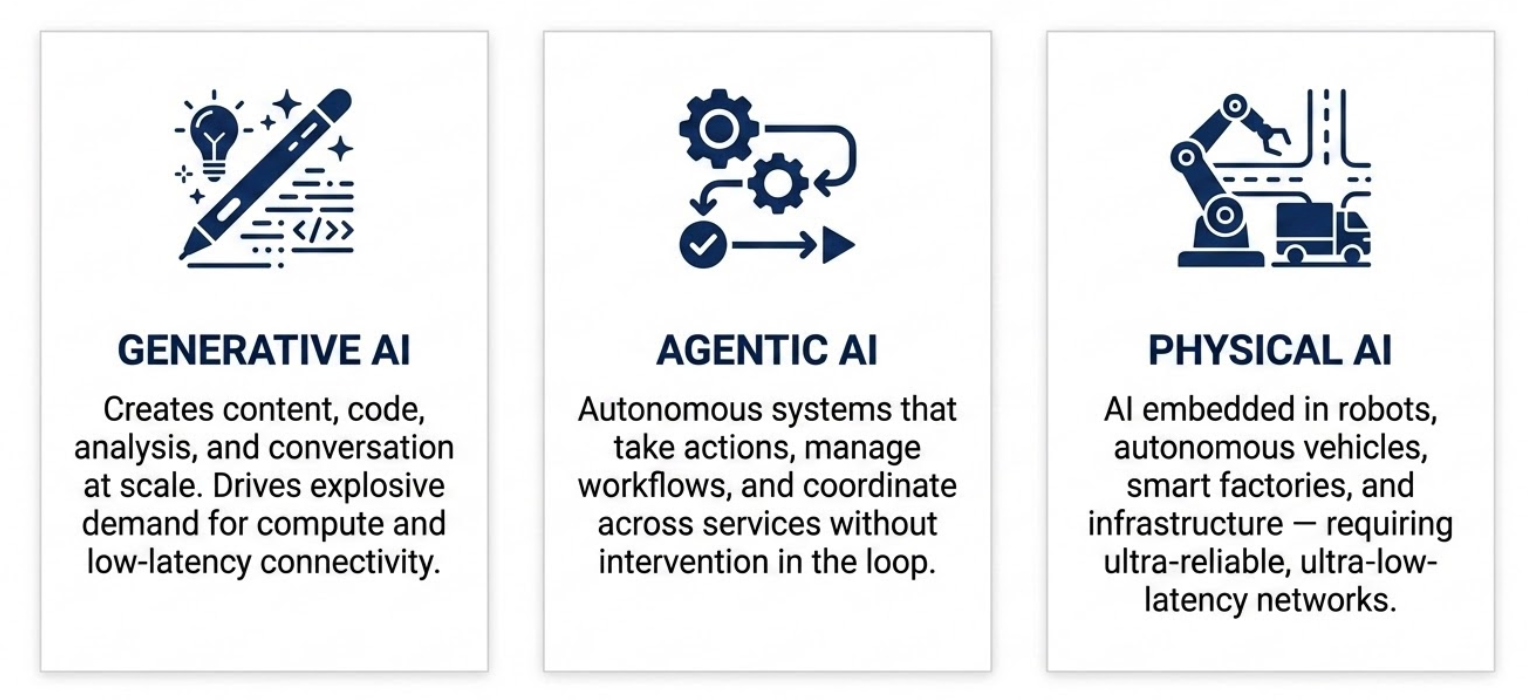
Together, these AI waves are doing much more than simply increasing bandwidth consumption or creating additional network traffic. They are beginning to redefine the very purpose of telecom infrastructure itself.
Traditional telecom networks were primarily designed to carry human-generated communication — voice calls, messages, video streaming, and internet traffic. But the AI era is pushing networks toward an entirely different role.
Future networks will increasingly need to support:
- Machine-to-machine communication
- Real-time AI inference
- Autonomous decision-making systems
- Edge intelligence
- Distributed AI workloads
- Ultra-low latency interactions between devices, applications, and AI agents
In many ways, telecom networks are evolving from passive connectivity layers into intelligent digital infrastructure platforms. And this is exactly the kind of transformation Andrew Grove would likely describe as a true 10x force.
The challenge is not simply that AI makes telecom operations more complex. The real shift is much deeper. AI is changing the fundamental question telecom operators need to ask themselves.
For decades, the telecom industry focused on one core objective: “How do we deliver connectivity efficiently?”
But the AI era is introducing a completely new strategic question: “How do we become intelligent infrastructure for an AI-driven world?”
Internet vs. AI: Mapping the Disruption
The parallels between the Internet disruption that Andrew Grove analyzed and the AI transformation unfolding today are remarkably striking. But at the same time, there are also important differences between the two eras. The Internet revolution primarily changed how people communicated, accessed information, and consumed digital services. It transformed human connectivity and created the foundation for the digital economy we know today.
| 🌐 Internet Era (1995–2010) | ◆ AI Era (2024–2035) |
|---|---|
| PRIMARY DISRUPTION
Voice calls commoditized; SMS disrupted by messaging apps; physical media eliminated |
PRIMARY DISRUPTION
Network operations automated; customer service replaced; BSS/OSS transformed by AI agents |
| TRAFFIC CHARACTER
Human-to-human and human-to-content; bursty, asymmetric, latency-tolerant |
TRAFFIC CHARACTER
Machine-to-machine and inference-driven; continuous, symmetric, ultra-low-latency critical |
| INFRASTRUCTURE DEMAND
Broadband buildout; fiber backhaul; data centers for OTT platforms |
INFRASTRUCTURE DEMAND
Edge compute nodes; AI inference clusters; private 5G/6G for enterprises; quantum-ready backbone |
| WINNER’S ADVANTAGE
Scale of subscribers and data volumes; spectrum holdings |
WINNER’S ADVANTAGE
Edge proximity; AI-native OSS/BSS; proprietary data for network optimization |
| BIGGEST OTT THREAT
Google, Facebook, WhatsApp — capturing consumer relationships and advertising |
BIGGEST OTT THREAT
Hyperscalers (AWS, Azure, Google Cloud) offering private wireless; AI companies building vertical stacks |
| TELECOM RESPONSE TIME
~15 years to fully adapt (2G→3G→4G→VoLTE) |
TELECOM RESPONSE TIME
Estimated 5–7 years before AI-native competitors establish dominant positions |
AI, however, is operating at a much deeper level. AI is not just changing communication. It is beginning to influence how decisions are made, how work gets executed, how enterprises operate, and even how physical systems interact with the world around them. The impact of AI extends beyond software applications or online experiences. It is gradually becoming embedded into operations, workflows, infrastructure, automation systems, and real-time business intelligence.
But perhaps the biggest difference between the Internet era and the AI era is speed. The Internet transformation gave telecom operators nearly fifteen years to adapt, experiment, consolidate, merge, and evolve their business models. The transition happened in phases — from dial-up connectivity to broadband, mobile internet, cloud computing, and eventually digital platforms.
The AI transformation, however, is moving at a much faster pace. The rapid evolution of large AI models, the aggressive expansion of hyperscaler edge infrastructure, and the rise of heavily funded AI-native companies are accelerating the shift much faster than previous technology cycles.
This means telecom operators may have a far smaller innovation window compared to what they had during the Internet revolution. The companies that recognize this shift early and reposition themselves strategically may define the next generation of intelligent digital infrastructure. The ones that move slowly may struggle to remain relevant in an AI-driven ecosystem.
Key Inflection Points for Telecom Operators
In my perspective, telecom operators are likely to encounter a series of incremental innovation inflection points over the coming years, as outlined in the table below.
Timeline Table
| Period | Inflection Point | What It Means for Telecom |
|---|---|---|
| 2026–27 | AI-native network operations emerge | Leading operators deploy large language models for autonomous fault detection, predictive maintenance, and dynamic spectrum allocation. Early adopters report 30–40% reduction in network operations costs. |
| 2027–28 | Agentic AI drives enterprise private network demand | Autonomous agents in manufacturing, logistics, and healthcare require dedicated, ultra-reliable private 5G networks. Telecoms that have built enterprise sales capabilities begin pulling away from those that haven’t. |
| 2028–30 | Physical AI reshapes network requirements | Autonomous vehicles, robotics, and smart infrastructure create demand for sub-millisecond latency at scale. Edge compute becomes as strategically important as spectrum. 6G standards begin incorporating AI natively. |
| 2030–32 | The intelligence layer battle | Hyperscalers and telecom operators compete for ownership of the “intelligent edge.” Operators with proprietary AI for network optimization command premium B2B pricing; others become wholesale bandwidth providers. |
| 2033–35 | Market structure crystallizes | A bifurcated industry emerges: AI-native telcos operating as intelligent infrastructure providers, and connectivity utilities competing purely on price. The gap between the two will be very difficult to close by this point. |
What Telecom Leaders Must Do Now
One of the biggest lessons from Andrew Grove is that disruption is not fatal — responding too late to disruption is. Telecom operators that survived the Internet era did so by accepting the commoditization of traditional voice revenues, making bold infrastructure investments, and finding new value in data and connectivity services. But the AI era is moving much faster and demands even deeper organizational transformation. Telecom companies now need to rethink their role beyond connectivity and prepare themselves to become intelligent infrastructure providers in an AI-driven world.
- Become AI-native: Rebuild OSS/BSS on AI foundations. Network operations must move from human-managed to AI-managed with human oversight. This is not an IT project — it is a core business transformation.
- Own the edge: Deploy distributed edge compute infrastructure before hyperscalers lock in enterprise customers. Edge proximity is the new spectrum — a finite, location-dependent strategic asset.
- Build for machines: Redesign network SLAs, APIs, and pricing for machine-to-machine traffic. The enterprise customer of 2030 is not a human subscriber — it is an autonomous system with deterministic connectivity needs.
- Monetize network data: Network operators possess uniquely valuable real-time data on traffic patterns, device behavior, and physical movement. This data, used responsibly, is a competitive moat no hyperscaler can replicate.
- Partner selectively: Not every AI capability needs to be built in-house. Strategic partnerships with AI infrastructure providers, while retaining ownership of network and customer relationships, can accelerate transformation without fatal dependency.
- Reskill aggressively: The telecom workforce of 2035 will look nothing like today’s. Network engineers will need AI literacy; data scientists will need network domain knowledge. Reskilling at scale is not optional — it is survival.
- Lead the regulation: AI in critical infrastructure will be regulated — heavily. Telecom operators who engage proactively in shaping AI governance frameworks will hold structural advantage over those who wait for rules to be imposed on them.
Conclusion: The Paranoid Survive. The Prepared Thrive.
The title of Only the Paranoid Survive was never meant to celebrate fear or constant anxiety.
What Andrew Grove was really emphasizing was the importance of staying alert to transformational change. The organizations that successfully survive major industry disruptions are usually not the ones that panic at the last moment. Instead, they are the ones that recognize the shift early, ask difficult strategic questions before others do, and take bold decisions before the market forces them into crisis mode.
That lesson became very visible during the Internet revolution. The Internet fundamentally transformed the telecom industry. It changed traffic patterns, business models, revenue streams, customer behavior, and the entire economics of communication. Yet telecom operators survived that disruption — and in many markets, they eventually grew stronger because of it.
The reason was simple: the world’s demand for connectivity continued to increase.
Once telecom companies understood how to position themselves in the Internet economy, the Internet became both a challenge and an opportunity. Operators that adapted successfully learned how to convert increasing data consumption into long-term infrastructure growth.
In many ways, the Internet became both a headwind and a tailwind at the same time. The companies that learned how to navigate it correctly managed to thrive in the new digital era.
Now, AI appears to be creating a very similar moment for the telecom industry once again. The 10x force is already arriving. The more important question is whether organizations are asking the right strategic questions early enough. AI is unlikely to reduce the importance of telecom infrastructure. In fact, it may dramatically increase the demand for connectivity over the next decade.
As AI agents, autonomous systems, connected machines, robotics platforms, edge intelligence, and machine-to-machine interactions continue to grow, every intelligent system could effectively become a network endpoint. This means future telecom networks may carry not only human communication, but also continuous AI-driven interactions between applications, systems, devices, and autonomous platforms.
So the real question is not whether telecom operators will have a role in the AI era.
The real question is this:
- Will today’s telecom operators become the companies that build and control the next generation of AI infrastructure?
- Or will the industry look back a decade from now and realize that a completely new set of infrastructure players moved faster and captured the opportunity first?


Be First to Comment