he recent TelecomTV panel discussion hosted by Ray Le Maistre offered valuable insights for telecom innovators.
One clear takeaway is that NVIDIA’s $1B investment in Nokia is far more than a strategic partnership — it represents a fundamental shift in how Radio Access Networks (RAN) are set to evolve in the age of AI.
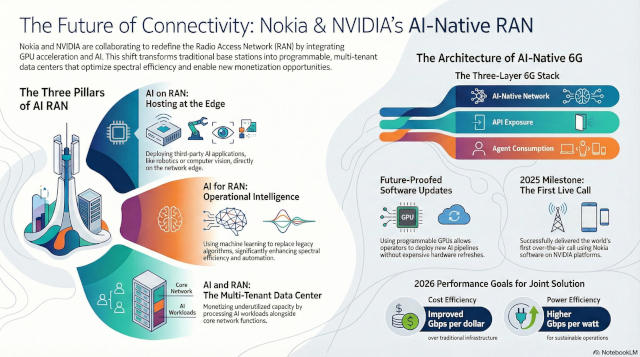
The core change is simple: instead of sending data back to centralized data centers, AI processing can now happen directly at the base station using GPU-accelerated computing. This turns the RAN into a software-defined, programmable, AI-ready platform — and a stepping stone toward AI-native 6G.
AI RAN can be understood in 3 dimensions:
| Pillar | Focus | Primary Benefit | Key Examples |
| AI on RAN | AI applications running over the network. | Enabling new edge services and “connecting intelligence”. | Computer vision, robotics, autonomous cars, and drone detection. |
| AI for RAN | Using AI to optimize the radio layer itself. | Drastic improvements in spectral efficiency and cost-per-GB. | Advanced beamforming, channel estimation, and ML-based MIMO receivers. |
| AI and RAN | Co-hosting AI workloads and network functions on the same hardware. | Monetizing underutilized compute capacity during non-peak hours. | “GPU-as-a-Service” or “Tokens-as-a-Service” (e.g., processing ChatGPT tokens). |
1. AI on RAN
This is about efficiently delivering AI workloads over the network — including LLM token delivery, computer vision, robotics, autonomous vehicles, and drone detection. Supporting these requires edge AI compute, strong uplink optimization (especially for video-heavy AI apps), programmable routing, and traffic prioritization. The network becomes optimized for AI traffic, particularly token-based inference workloads.
2. AI for RAN
Here, AI improves the network itself. Beyond operational automation, the biggest impact is on spectral efficiency. With GPU-based computing, operators can deploy advanced beamforming, ML-based channel estimation, multi-user MIMO pairing, and AI-driven link adaptation. The outcome is clear: higher Gbps per dollar, better Gbps per watt, and improved spectrum utilization.
3. AI and RAN
This is the monetization opportunity. RAN is built for peak traffic and remains underutilized most of the time. With GPU platforms, RAN and AI workloads can co-exist. When traffic is low, compute capacity can process AI tokens. Base stations effectively become distributed AI mini data centers. This opens revenue models such as Token-as-a-Service and GPU-as-a-Service, increasing utilization from ~30% to 80–90% and significantly improving ROI.
Architecture for AI-Native 6G
Mikko Jarva (Nokia) describes a three-layer architecture for this future: an AI-native network platform, an AI-native exposure layer (APIs), and consumption via AI agents. The discussion highlights three architectural layers:
1. AI-Native Network Layer
- Software-defined RAN, Core, and management
- Accelerated compute everywhere
2. AI-Native Exposure Layer
- APIs
- Agent-based interfaces
- Network capability exposure
3. Consumption Layer based on AI Agents
- External AI agents dynamically shaping and using the network
- Enterprise AI interacting directly with network capabilities
This architecture is considered a “stepping stone” to 6G. Since it is entirely software-defined, operators can update algorithms (like DeepRx or DeepTx) via software without needing a full hardware refresh.
In 2025, the partnership achieved the world’s first live over-the-air call using Nokia software on an NVIDIA platform. For 2026, the focus is on proving the solution’s superiority in terms of power efficiency (Gbps per watt) and cost-effectiveness (Gbps per dollar).
## Strategic Takeaways
AI RAN is not a minor evolution; it is foundational for 6G. The real shift lies in programmability. The RAN is evolving from a connectivity infrastructure into a distributed AI compute fabric. This creates new monetization opportunities, enhances efficiency, and provides a credible path toward AI-native networks.
This solution will be showcased at the upcoming Mobile World Congress 2026, making the event even more compelling & worth following closely.
Link to panel discussion: https://www.telecomtv.com/content/nokia-building-profitable-ai-native-networks/building-profitable-ai-native-networks-from-5g-advanced-to-6g-live-broadcast-54856/

Be First to Comment