Year after year, as the AI wave accelerates, we see its imprint becoming deeper and more structural across the telecom and networking landscape. At Mobile World Congress 2026, that shift is unmistakable.
The energy in the MWC halls feels different this year.
The conversation is no longer about simply getting connected. It is about getting intelligent. The industry is moving beyond transporting bits and bytes. Leading players are now demonstrating how networks can think, self-protect, self-optimize, and even anticipate demand before it materializes.
At a time when AI infrastructure is scaling rapidly — powered by massive chip capacity and hyperscale compute — the telecom sector is clearly taking note. The dialogue at MWC 2026 is not just about AI for networks, but equally about networks for AI. That dual transformation may define the next decade of telecom evolution.
At a high level, here is how four major leaders are reshaping the narrative this year:
SK Telecom – AI as Network Brain
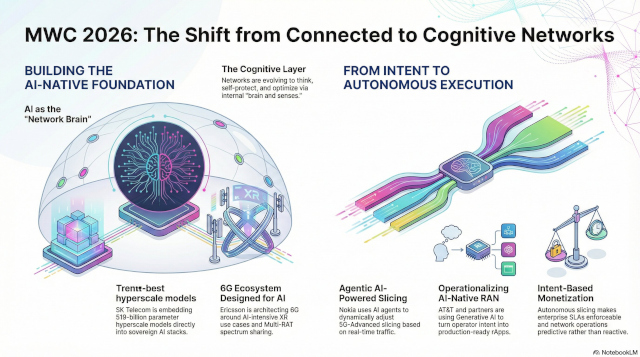
SK Telecom is showcasing a live demonstration of A.X K1, its 519-billion parameter hyperscale model, alongside its AI-native network and AI data center architecture.
This is more than a model demo. It signals an operator investing in sovereign AI stacks and embedding intelligence directly into network infrastructure. The vision positions AI not as an external tool, but as the cognitive layer — the “brain and senses” — of next-generation telecom systems.
This represents a strategic shift: operators are no longer just connectivity providers; they are becoming AI infrastructure platforms.
Ericsson – 6G Designed for an AI World
Ericsson’s 6G ecosystem demo with Apple and MediaTek highlights Multi-RAT Spectrum Sharing (MRSS), enabling 5G and 6G to coexist within the same spectrum band. The demonstration also features a 6G centimeter-wave data call supporting low-latency, AI-enhanced XR experiences.
This is critical for two reasons:
First, spectrum efficiency will determine how quickly 6G scales commercially. Second, 6G is clearly being architected around AI-driven use cases from day one.
Rather than designing a network first and finding applications later, Ericsson is showing what a network built for immersive, AI-intensive services looks like.
Nokia – Intent Becomes Execution
Nokia, in partnership with AWS, is presenting agentic AI-powered 5G-Advanced slicing. Instead of manually configuring slices, AI agents dynamically adjust policies based on real-time inputs such as traffic patterns and environmental conditions.
This marks a significant move toward intent-based networking. Operators define business intent, and AI translates that intent into executable network policies.
If slicing becomes adaptive and autonomous, monetization becomes practical. Enterprise SLAs become enforceable. Network operations become predictive instead of reactive.
This is a foundational step toward truly autonomous networks.
AT&T + Aira Technologies + Ericsson – Operationalizing AI-Native RAN
In one of the most practically important demonstrations, AT&T, Aira Technologies, and Ericsson are showing how operator intent can be translated into deployable rApps using Generative AI.
More importantly, they are demonstrating validation, governance, and operationalization within real operator environments.
The industry has long discussed Open RAN and AI-driven RIC ecosystems. But turning intent into safe, deployable rApps — and ensuring those applications are controlled and production-ready — is the real challenge.
This collaboration bridges the gap between AI experimentation and AI-native RAN operations.
The Bigger Picture
The common thread across these demonstrations is clear:
The network is no longer a “dumb pipe.” It is becoming Cognitive, Adaptive, Secure by design an Intent-driven.
Whether it is SK Telecom embedding hyperscale AI into infrastructure, Nokia enabling autonomous slicing, Ericsson advancing AI-ready 6G evolution, or AT&T and partners operationalizing AI in the RAN, the direction is unmistakable.
The networking fabric is being redesigned to think and respond in real time.
MWC 2026 may well be remembered as the moment when telecom moved decisively beyond customer-experience-focused AI use cases and began embedding intelligence into the core of network architecture itself.
And this is likely just the beginning.
I am confident we will see many more innovations unfold at MWC 2026 that reinforce this shift — from connected networks to cognitive networks.

Be First to Comment