For any AI to thrive, it requires a steady diet of high-quality data. In the sprawling world of telecommunications, the potential data sources are nearly infinite. However, as our networks evolve into hyper-complex ecosystems—spanning 5G radios, transport fibers, edge interfaces, and distributed cloud instances—we have reached a critical bottleneck. Traditional AI methodologies are hitting a wall, acting as the primary catalyst for the architectural breakthroughs we are seeing today.
In this post, we’re diving deep into the evolution that is turning network management from a reactive task into a predictive science.
The MWC 2026 Shift: Beyond Log Files
Mobile World Congress (MWC) 2026 was a landmark moment for global operators. It provided a clear view of how AI is being disrupted and showcased a growing diversity in automation mechanisms. We are witnessing a fundamental paradigm shift: Telcos are moving from “AI that reads logs” to “AI that understands the map.”
The Current Landscape: Breaking the Silos
Currently, most Tier-1 telcos operate at TM Forum Level 2 or 3 autonomy. In these environments, manual intervention is still the safety net. AIOps platforms can suggest a fix, but a human engineer in the Network Operations Center (NOC) must still hit “Approve.”
Furthermore, these implementations are often hindered by “siloed intelligence”—where AI models run independently for the Radio Access Network (RAN) and the Core, unable to see the “big picture” of how a fault in one impacts the performance of the other.
What Makes MasOrange Different?
MasOrange is breaking this mold by moving toward a truly “Zero-Touch” philosophy. They have introduced a pioneering approach to AIOps that leverages Advanced Graph Machine Learning (GraphML).
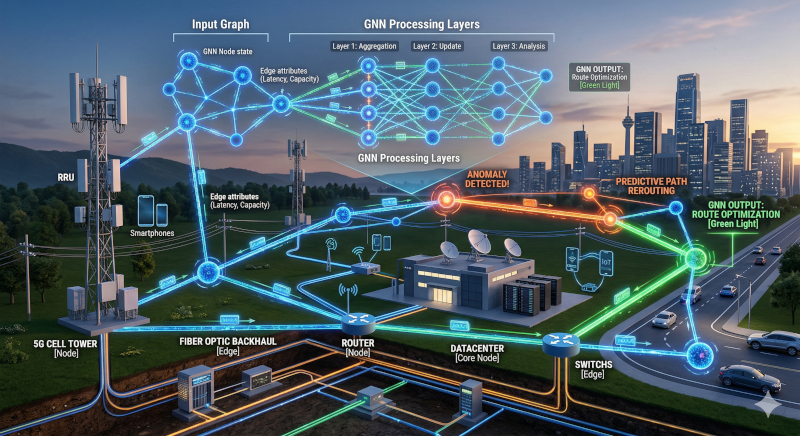
By applying Graph Neural Networks (GNNs) to a sophisticated Network Digital Twin, MasOrange can analyze, predict, and proactively remediate issues on a live network before they ever reach the customer’s device. In this high-stakes architecture, the Digital Twin isn’t just a visualization—it is the critical engine room for decision-making.
Understanding the Tech: From Neural Networks to GNNs
To appreciate this leap, we have to look at the evolution of the underlying math:
- Neural Networks: Inspired by the human brain, these models use interconnected “neurons” in layered structures to recognize patterns. They are excellent at mapping inputs to outputs—like translating languages—by adjusting internal weights to minimize error.
- Graph Neural Networks (GNNs): This is the next frontier. While traditional neural networks handle structured, “flat” data (like images or text grids), GNNs are designed to learn directly from complex, irregular structures. They excel at node classification, edge prediction, and graph classification—making them perfect for a network of connected nodes.
When MasOrange deploys this, their AIOps engine isn’t just a database sitting on the sidelines; it’s a living, breathing mathematical representation of the network topology.
A Living Map for a 5G-Advanced World
The beauty of the GNN concept lies in its natural alignment with the web-like complexity of 5G-Advanced (5G-A) architectures. By treating the network as a “living map,” MasOrange’s system can:
- Understand Relational Context: It knows how a specific software instance in the cloud relates to a physical fiber path and a specific 5G cell.
- Execute Path Tracing: It can see how a failure “ripples” through the topology, pinpointing the root cause in seconds rather than hours.
- Predictive Remediation: It identifies structural “strains” in the network, predicting glitches before they manifest as dropped calls or slow data.
The Road to Level 4 Autonomy
Partnering with NetAI as the GNN provider for this MWC 2026 showcase, MasOrange is setting a new industry gold standard. Already a frontrunner in 5G Standalone (SA) deployments—and having recently clocked a record-breaking 2 Tbps data transfer rate—they are now focused on the intelligence layer.
With this GraphML-driven implementation, MasOrange is poised to achieve Level 4 Autonomy. They are proving that the future of telecom isn’t just about raw speed; it’s about a network that possesses the situational awareness to manage itself.
Featured Image generated by Gemini 3.1 Pro (Nano Banana 2) on April 6, 2026.


Be First to Comment