This article kicks off a series of case studies highlighting how AI is transforming telecom network operations.
Every once in a while, nature puts critical infrastructure to the ultimate test. In densely populated regions, natural disasters can cripple essential services, including telecommunications. These are the moments when technology (especially AI) must prove its true value.
Between January 23 and January 27, 2026, such a moment unfolded in the United States when Winter Storm Fern struck with heavy snow, ice, and widespread power outages. During this crisis, T-Mobile demonstrated how autonomous networks powered by AI can help maintain connectivity even in extreme conditions.
The case quickly became one of the most discussed real-world examples of AI-driven network resilience at Mobile World Congress 2026, where the telecom industry closely examined how intelligent automation can strengthen network operations during disasters.
When Disaster Strikes: The Challenge for Telecom Networks
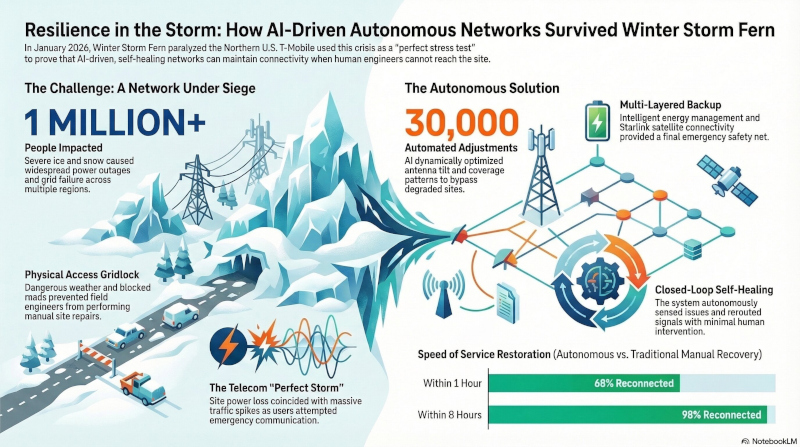
Winter Storm Fern caused widespread disruption across several regions in the North U.S. The storm resulted in severe snowfall, icy conditions, and extensive power outages affecting more than one million people. For telecom operators, such conditions create multiple operational challenges:
- Cell sites losing power due to grid outages
- Sudden spikes in network traffic as people attempt to communicate
- Limited physical access for field engineers because of blocked roads and dangerous weather
These factors together create a perfect stress test for telecom infrastructure, particularly for operators striving to build autonomous networks.
How T-Mobile’s Autonomous Network Responded
To maintain service during the storm, T-Mobile relied on its AI-driven Self-Organizing Network (SON) combined with advanced automation capabilities.
Autonomous Radio Optimization
One of the most critical actions performed by the network was dynamic radio optimization. During the storm, the system executed around 30,000 automated antenna adjustments.
Using AI, the network was able to:
- Dynamically adjust antenna tilt and coverage patterns
- Optimize coverage in areas where certain sites were degraded or overloaded
- Redirect traffic to neighboring cell sites to maintain service continuity
Self-Healing Network Behavior: The network also demonstrated self-healing capabilities. When certain base stations experienced performance degradation, the system automatically rerouted signals through nearby sites to maintain coverage.
AI-Driven Monitoring and Incident Response: AI tools continuously monitored weather data and network conditions in real time. Platforms such as Dataminr and Everbridge helped identify emerging risks and enabled coordinated operational responses across the network.
Intelligent Energy Management: Power outages are one of the biggest threats to telecom infrastructure during storms. Automation systems optimized energy usage at cell sites, extending battery and generator life to keep sites operational for longer durations.
Satellite Backup Connectivity: As an additional resilience layer, T-Mobile’s satellite connectivity service using Starlink was temporarily activated for free during the storm. This provided basic texting and emergency alert capabilities for users who were completely out of range of terrestrial towers.
The Results
Despite the severity of the storm, the network demonstrated impressive recovery performance.
According to T-Mobile CTO @John Saw:
- 68% of affected customers reconnected within the first hour
- 98% of customers regained connectivity within eight hours
In many instances, customers were able to reconnect to the mobile network even before electricity was restored to their homes.
Why This Case Study Matters
For telecom industry leaders, the Winter Storm Fern case highlights an important shift in network operations — the evolution from network automation to truly autonomous networks.
Several strategic lessons emerge from this example:
1. Closed-Loop AI Operations
The network demonstrated real-time closed-loop automation:
AI sensing → AI decision → automated network action
All of this happened with minimal human intervention.
2. Autonomous RAN Optimization: Radio access networks (RAN) dynamically adjusted operational parameters during disruptions, ensuring optimal coverage and traffic distribution.
3. Network Resilience as a Core Requirement: With the rise of 5G Fixed Wireless Access (FWA), enterprise connectivity, and mission-critical applications, telecom networks can no longer tolerate prolonged downtime Resilience must be built directly into the network architecture.
4. Progress Toward Level-4 Autonomous Networks: The industry is moving toward Level-4 autonomous networks, where operations become largely zero-touch, enabling networks to self-configure, self-optimize, and self-heal.
A Fundamental Shift in Network Operations
This case also highlights how telecom network management is evolving.
Traditional Network Operations
Engineers detect outages → teams investigate → manual intervention restores service.
Autonomous Network Operations
Network detects degradation → AI analyzes the issue → automated radio adjustments restore service before customers even notice.
For years, telecom operators have talked about the vision of self-healing networks. The Winter Storm Fern event demonstrates that this vision is no longer theoretical—it is becoming operational reality.
References:
- https://www.t-mobile.com/news/network/t-mobiles-readiness-in-motion-as-widespread-winter-storm-fern-approaches
- https://www.fierce-network.com/wireless/mwc-t-mobile-cto-talks-big-autonomous-network-ambitions
- https://www.linkedin.com/posts/john-saw-86101b5_teammagenta-activity-7421689831677689856-4IEw/

Be First to Comment