I have been closely monitoring SK Telecom’s aggressive surge as a Global AI Company, a transition fueled by the AI boom that is currently disrupting the entire telecommunications landscape. SKT has decisively carved its own path by smartly integrating telco-specific expertise with a vision of becoming a “full-stack” AI powerhouse.
This article serves as a case study, detailing how they navigated a catastrophic security breach in 2025 and are now leveraging AI to reclaim their momentum and set a new benchmark for the industry.
2025: The “Reset Year”
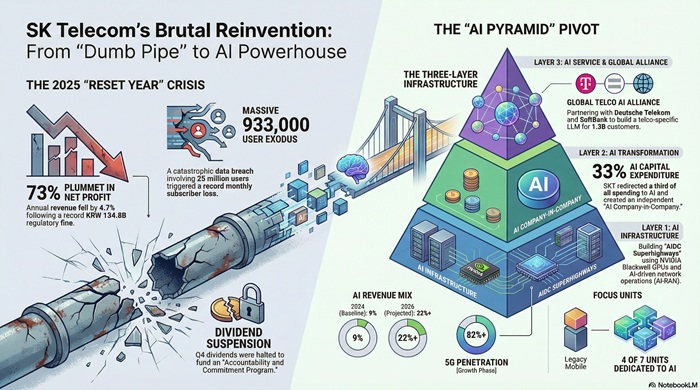
In April 2025, SKT hit a wall when a catastrophic data breach exposed SIM-related data for nearly its entire 25 million-user base, triggering a record exodus of 933,000 users in a single month. The financial fallout was staggering: annual revenue declined by 4.7% to KRW 17.09 trillion, and net profit plummeted 73% year-over-year.
The company also faced a record KRW 134.8B ($97M) regulatory fine and was forced to suspend its Q4 2025 dividends to fund an “Accountability and Commitment Program”. For most, this would be a decade-long setback, but for SKT, it became a catalyst to decouple from the stagnating mobile market and go “all-in” on AI.
The AI Pyramid Strategy
SKT re-engineered its entire organization into a three-layer “AI Pyramid” strategy. At the Infrastructure layer, they are building the “AIDC Superhighway” with 1GW+ capacity and becoming a primary provider of NVIDIA Blackwell GPUs via GPU-as-a-Service.
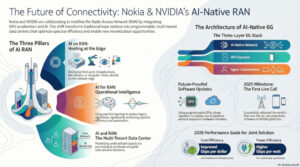
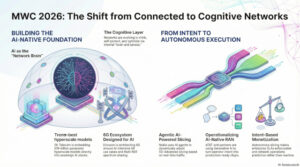
In the Transformation (AIX) layer, they implemented AI-RAN to target a 20% reduction in network OpEx. Finally, at the Service layer, they scaled their AI assistant A. (A-Dot) to over 11 million users while preparing the global launch of “Agentic AI”. (https://www.sktelecom.com/en/press/press_detail.do?idx=1582)
The Strategy for Further Growth
SKT’s recovery is rooted in big structural changes. They appointed a legal and compliance expert, Jung Jaihun, as CEO to signal “governance first” to global investors and restructured the company into seven distinct units, four of which are dedicated exclusively to AI.
To fuel this, they pushed AI-related capital expenditure to 33% and created an independent “AI Company-in-Company” (AI CIC) to bypass legacy bureaucracy. Furthermore, they spearheaded the Global Telco AI Alliance with partners like Deutsche Telekom and SoftBank to build the world’s first telco-specific LLM, allowing them to localize AI for 1.3 billion customers globally.
The 2026 Outlook
By February 2026, SKT’s “green shoots” are undeniable. AI revenue is set to hit 22%+, up from 9% in 2024, with 5G penetration reaching 82%+. Most critically, dividends resume in Q2 2026.
SKT proves that legacy carriers can leverage deep crises to force a total evolution into “full-stack” AI powerhouses.
In my view, this stands as the most compelling case study available in the current AI era.

Be First to Comment