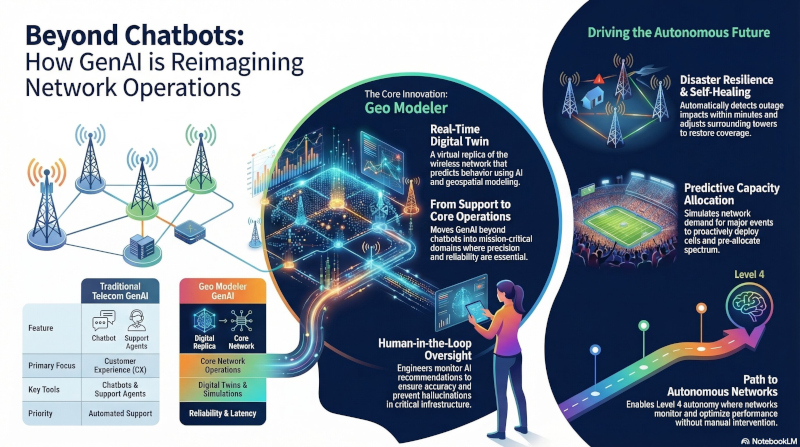
Most discussions around Generative AI in telecom today focus on customer experience — chatbots, service agents, and automated support systems. However, a recent innovation from AT&T shows that generative AI is now beginning to transform core network operations as well.
A few days ago, Raj Savoor from AT&T highlighted an interesting development in a blog discussing the work of a researcher Velin Kounev and his team. The innovation is called Geo Modeler — an AI-powered simulation platform designed to improve how telecom networks are planned, operated, and optimized.
While it may not yet be presented as a formal industry case study (like I did for T-Mobile), Geo Modeler represents a significant shift in how AI can be used to manage telecom networks.
Geo Modeler is a Generative AI–based network simulation and decision engine that creates a real-time digital twin of a mobile network. In simple terms, the system builds a virtual replica of the wireless network and runs AI-driven simulations to predict network behavior before real-world events occur.
By combining AI, machine learning, geospatial modeling, and network data, Geo Modeler helps operators: predict coverage behavior, identify potential service disruptions and, optimize network configuration automatically.
The ultimate goal of this solution is to improve network performance, resilience, and service reliability for both consumers and enterprise users.
Why This Innovation Matters
The development of Geo Modeler reflects an important shift in telecom AI adoption. Until recently, generative AI was largely associated with: customer service automation , AI-powered contact centers and personalized customer engagement. Geo Modeler shows that Generative AI is now entering the domain of telecom network operations, where reliability, precision, and operational efficiency are critical. This shift could play a key role in enabling autonomous networks, where AI systems continuously monitor and optimize network performance without requiring manual intervention.
The detailed technical approach behind how this platform works has been explained in the announcement post published by AT&T.
According to AT&T, the platform has been designed with the future of connectivity in mind. Emerging technologies such as: drones, robotics and autonomous vehicles will require ultra-reliable connectivity in constantly changing environments, often prioritizing network reliability and latency over raw bandwidth.
Velin Kounev and his team developed Geo Modeler to address these future requirements by enabling networks to predict and adapt to changing connectivity conditions in real time.
Use Cases
- Disaster Resilience: When disasters occur: towers fail, power outages happen, backhaul breaks and traffic spikes, Geo Modeler can: detect outage impact within minutes, simulate coverage loss and adjust surrounding towers automatically
- Autonomous Network healing: Enables self-healing networks. This is a major step towards level 4 autonomous networks.
- Network planning for major events: Geo Modeler enables operators to simulate network demand for sports events, concerts, festivals, and political rallies, allowing them to proactively deploy temporary cells, adjust antenna patterns, and pre-allocate spectrum.
- Drone and emergency connectivity: Model model connectivity for drones used by first responders. It determines: optimal altitude, flight path and signal quality along the route
- Predictive Capacity Allocation: Predicts traffic surges, congestion, coverage degradation and proactively adjusts the network.
One important point highlighted by AT&T is the human oversight involved in the system. Network feedback data used by Geo Modeler is closely monitored by engineers to ensure the AI system provides accurate recommendations and avoids potential hallucinations. This human-in-the-loop approach is critical because telecom networks are mission-critical infrastructure, where incorrect decisions could impact millions of users. The presence of human validation helps build trust in AI-driven network automation system.
Sources:





Be First to Comment