Energy preservation isn’t just a green initiative anymore—it’s a global necessity, and for any organization, it’s now paramount. With geopolitical instability adding pressure, energy is moving to the absolute top of the priority list for everyone.
The good news? The telecom industry has been ahead of the curve. For the past decade, operators have been racing to integrate AI and Machine Learning (ML) to dramatically boost energy efficiency across their massive networks.
However, the game is getting harder. The incoming wave of advanced, power-hungry chips needed for next-gen networks is posing fresh, significant challenges to this critical mission. But true to form, operators are innovating and finding smart ways to overcome this hurdle.
The pursuit of “leaner and greener” networks has already led to impressive results. We’ve seen numerous successful demonstrations and real-world implementations that prove efficiency and performance can go hand-in-hand. This is one battle the industry is committed to winning.
This table lists all the projects and efforts telcos are undertaking to use energy more efficiently. I gathered this information from studies and examples published by TMForum and GSMA.
Global Implementations
| Telecom Operator | AI Strategy / Energy Saving Method | Reported Impact |
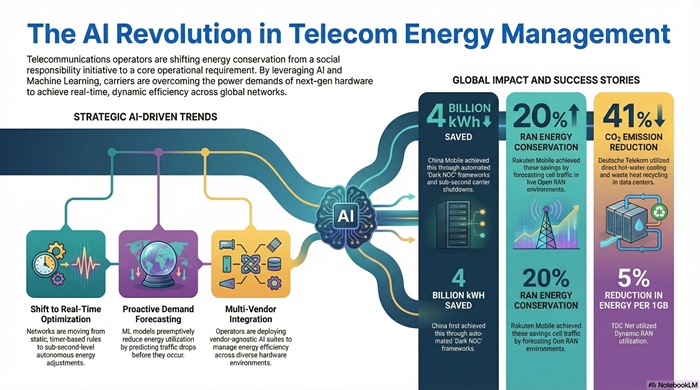
| China Mobile | Deployed an automated, AI-driven “Dark NOC” framework and intelligent deployments like sub-second-level carrier shutdowns and ultimate dormancy. | Saved 4 billion kilowatt-hours of electricity. |
| Rakuten Mobile | Deployed AI/ML applications to forecast cell traffic and make real-time energy-saving decisions in a live Open RAN environment. | Estimated 20% conservation in RAN energy. |
| Jio | Uses AI algorithms to analyze real-time traffic and automatically switch off specific spectrum bands during low-usage hours (02:00 to 05:00). | Significantly reduced power consumption. |
| TDC Net (Denmark) | Dynamically adjusts RAN energy utilization based on traffic profiles. | 5% reduction in energy per 1GB of data (~800MWh savings). |
| Globe Telecom | Deployed an AI-driven RAN automation suite across a multi-vendor network. | Up to 5.5% nationwide RAN energy reduction over seven months. |
| Indosat Ooredoo Hutchison | Deployed a nationwide cloud-based AI solution that automatically idles radios during low demand. | Material RAN energy savings while sustaining performance. |
| Turkcell | Developed an AI-assisted sector shutdown algorithm to identify and safely shut down low-traffic sectors. | Energy reduction without service interruptions. |
| Telenor (Norway) | Used an autonomous AI agent to increase the time radio cells spend in “active sleep mode”. | 4% energy saving for specific radio cells. |
| True Corporation (Thailand) | Uses AI to automatically reduce or reactivate energy consumption based on demand. | Achieved Level 4 certification for RAN energy efficiency. |
| AIS (Thailand) | Tracks energy savings as a high-value KPI in its progression toward Level 4 autonomous networks. | Prioritized RAN energy efficiency optimization. |
| Deutsche Telekom | Uses a system with direct hot-water cooling and feeds waste heat back into buildings. | 41% reduction in data center CO2 emissions. |
| Bell Canada | Field-tested AI-native link adaptation to improve downlink and spectral efficiency. | Reduced energy required per bit. |
| Airtel | Launched a vendor-agnostic AI/ML solution to dynamically optimize cell sleep patterns. | Significant operational cost and energy reduction. |
So, what fascinating trends are emerging from the case studies we’ve examined? Let’s dive in!
Trends in Energy Optimization
The sector is witnessing several pivotal shifts in how energy is managed:
- The industry is moving away from static, timer-based rules toward real-time, AI-driven adjustments. Jio and Airtel utilize AI to optimize spectrum bands and cell sleep patterns during low-usage windows, while China Mobile has reached “sub-second-level” carrier shutdowns for maximum precision.
- Proactive energy saving is the new standard. Operators like Rakuten Mobile and TDC Net utilize ML to preemptively reduce energy utilization by forecasting demand before it drops, ensuring a seamless user experience.
- AI is being woven into the broader operational fabric, such as “Dark NOCs” that automate energy savings across diverse environments. This often occurs alongside the decommissioning of legacy copper infrastructure.
- To achieve nationwide impact, operators like Airtel and Globe Telecom are deploying AI suites that function across multi-vendor hardware environments, preventing efficiency “silos”.
- While much focus remains on the Radio Access Network (RAN), innovations in data center cooling—such as those by Deutsche Telekom—demonstrate the value of recycling waste heat.
What did the survey participants say in the TM Forum evaluation?
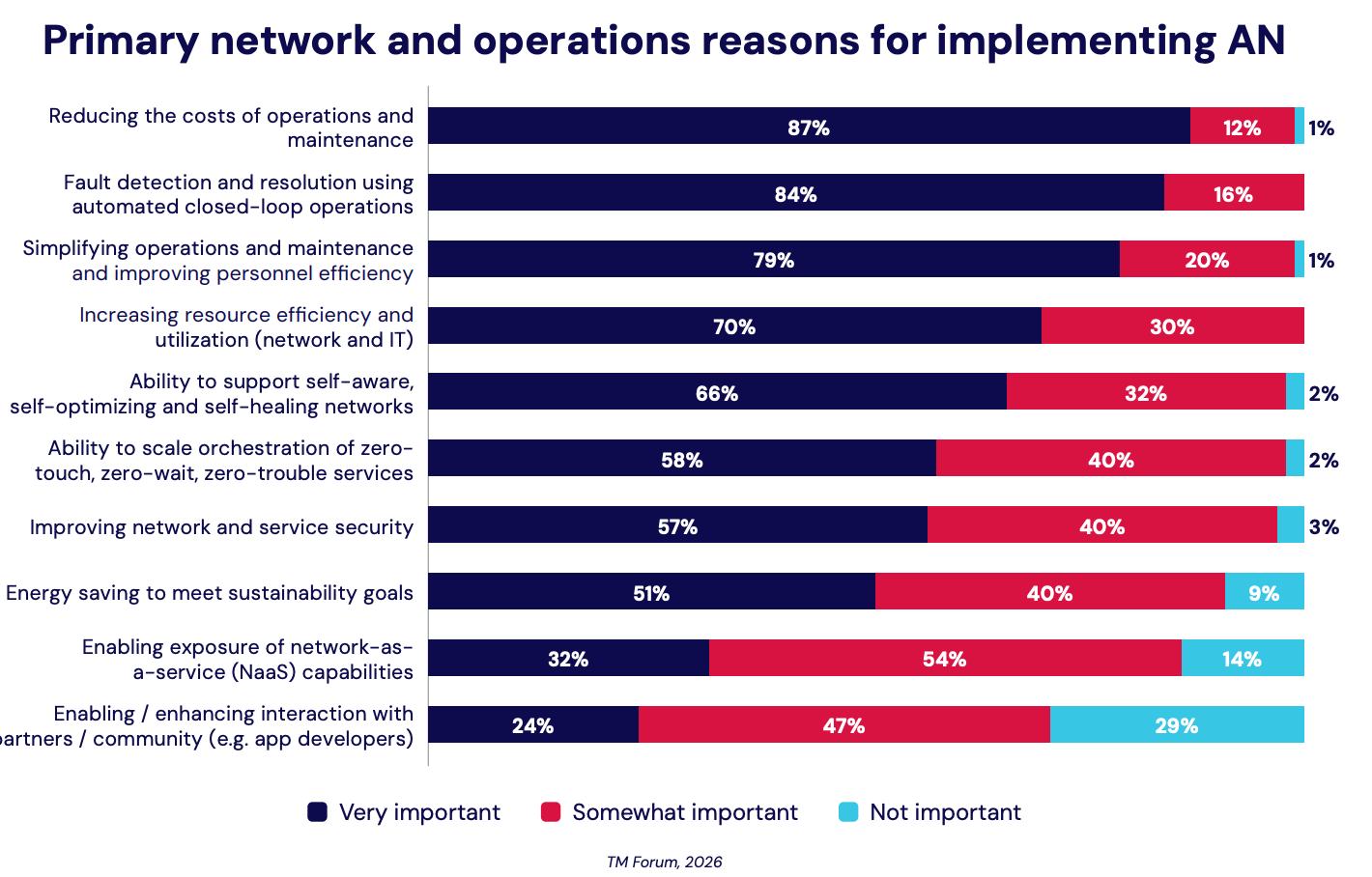
According to recent TM Forum survey data, sustainability-driven energy savings currently rank lower among the primary drivers for deploying AI-powered autonomous networks. However, given the current global trajectory, it is highly probable that energy efficiency will emerge as a top-three priority in the coming year.
My Take
Based on the curated trends and the success stories we’re seeing across the globe, it is clear that Dynamic Power Management has emerged as the “heavy hitter” for energy preservation in the Radio Access Network (RAN) and other network components.
For years, we relied on static, “set-it-and-forget-it” policies—basically digital timers that turned things down at a specific hour regardless of what was actually happening on the ground. But those days are over. We are now seeing a sophisticated shift where operators are deploying AI agents and machine learning models that act as the “brain” of the network. These systems don’t just watch the clock; they perform deep, real-time analysis of traffic patterns. By accurately predicting capacity needs before they even happen, the network can breathe—expanding and contracting its energy footprint dynamically.
When we look under the hood, the technical optimizations are truly impressive:
- Automated Active Sleep Modes: This isn’t just a “standby” light. It’s the ability for hardware to intelligently transition into deep, low-power states the moment activity drops.
- Intelligent Radio Idling: If there’s no User Equipment (UE) detected in an area, why keep the radio fully powered? AI can now idle specific components in a heartbeat.
- Sub-second Carrier/Sector Shutdowns: This is where it gets really surgical. We’re talking about deactivating entire capacity layers in less than a second during traffic lulls, and snapping them back to life before a user even notices a dip in signal.
>This move from a reactive “wait-and-see” approach to a proactive, demand-aware framework is a total game-changer. It allows us to slash power overhead significantly without compromising the rigorous Quality of Service (QoS) or the KPIs that keep customers happy.
>Looking ahead, I believe the scope of these AI use cases is only going to grow. However, we have to be realistic—the telecom world doesn’t exist in a vacuum. Our strategic priorities are constantly being reshaped by a volatile geopolitical landscape and shifting economic pressures.
The next 24 to 36 months are going to be a defining “balancing act” for operators. We are entering a period where the winners will be those who can expertly pivot their focus between three critical pillars: aggressive cost reduction, radical energy efficiency, and the total optimization of network operations. It’s a complex puzzle, but with AI-native infrastructure, we finally have the tools to solve it.






Be First to Comment