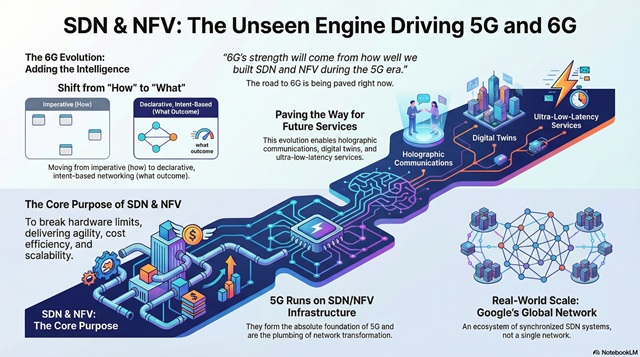
SDN and NFV have quietly been doing the heavy lifting in telecom for more than a decade.
Since their arrival, SDN and NFV have formed the absolute foundation of 5G — and they will remain the evolutionary baseline for 6G. Every promise we associate with 6G today rests on decisions made during the 5G era.
One of the most cited examples of SDN at scale is Google’s global network. What’s interesting is not just the size, but the architecture. Google doesn’t run “one SDN network” — it operates a globally synchronized ecosystem of SDN systems, spanning data centers, WAN, virtualization layers, and peering edges. That level of software control is what true scale looks like.
In telecom and IT, SDN and NFV exist to break the limits of hardware-centric networks. Together, they deliver agility, cost efficiency, and scalability — essential for 5G, cloud, and edge environments.
Here’s the reality:
- If you are deploying 5G today, you are building SDN/NFV infrastructure. This is the plumbing of network transformation.
- If you are thinking about 6G, you are thinking about the intelligence that controls that plumbing. You cannot get to 6G without the SDN/NFV foundation laid during the 5G phase.
We’re already seeing this evolution in real deployments:
- AI-powered SDN monitoring is being used for predictive analytics across large production networks
- SDN/NFV combined with AI-based anomaly detection is improving security and reliability across 5G and early 6G slices
- Automation is significantly reducing manual configuration while improving scalability
- Cloud-native, microservice-based VNFs and open interfaces are becoming the norm
- ETSI is advancing NFV-MANO with multi-tenancy, service-based architectures, and CI/CD for autonomous networks
On the innovation side, SDN is moving toward zero-touch operations and deep edge intelligence, with distributed AI agents increasingly taking control decisions closer to the network edge. NFV is evolving toward more granular, microservice-driven and even serverless architectures.
We are also seeing a shift from:
- Imperative SDN (telling the network exactly how to behave)
to - Declarative or intent-based SDN (telling the network what outcome we want)
This shift becomes critical in 6G, where networks must dynamically support holographic communications, digital twins, and ultra-low-latency services through real-time edge intelligence.
At ACL Digital, we’ve been working at the heart of this transformation — supporting leading telecom and networking players with services and R&D expertise in SDN and NFV, and being early adopters and contributors in NFV-driven architectures. Our teams are already helping customers design, build, and scale these foundations — because the road to 6G is being paved right now.
The message is simple:
6G will look revolutionary on the surface — but its real strength will come from how well we built SDN and NFV during the 5G era.





Be First to Comment