Every organization today is on a journey to become AI-powered—but that ambition only matters if it meets clear benchmarks. For telecom operators, the bar is even higher, with industry-specific challenges and expectations that must be addressed to truly qualify as AI-driven.
McKinsey & Company’s AI Transformation Manifesto offers a sharp lens on this gap. It outlines 12 themes that separate real AI leaders from the rest—and one idea stands out: competitive advantage doesn’t come from adopting AI faster, but from rewiring the business around it.
For telcos, this is not a technology upgrade. It’s a structural shift. Today, most operators are stuck in fragmented AI adoption—network optimization here, chatbots there, some analytics on customer data. These initiatives create incremental value, but rarely impact core metrics like ARPU, churn, or cost-per-bit.
So where should telcos really focus?
-
- Build capabilities, not use cases: AI advantage comes from strong foundations—data, platforms, talent, and operating models—not isolated deployments. Telcos must move from vendor-led AI experiments to owning AI capabilities across the stack.
-
-
- Double down on economic leverage points: Stop spreading AI investments across dozens of pilots. Focus where the real business impact lies:
- Network operations (autonomy, energy optimization, predictive maintenance)
- Customer experience (proactive, AI-led journeys)
- Service provisioning (zero-touch, faster rollout)
- OSS/BSS (AI-native orchestration)Double down on economic leverage points: Stop spreading AI investments across dozens of pilots. Focus where the real business impact lies:
If AI is not improving capital efficiency or reducing cost-per-bit, it’s not solving the right problem.
-
- Fix leadership, not just technology: AI transformation is not an IT initiative. It must be business-led. Leaders need to understand AI, own outcomes, and drive adoption end-to-end. Delegating this to technology teams is where most transformations fail.
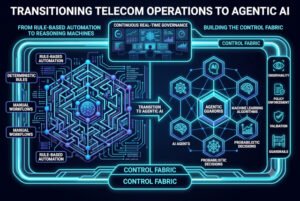
- Prepare for agentic AI: The next wave is not just AI models—it’s autonomous systems. Think AI agents that manage networks, resolve faults, optimize traffic, and orchestrate services in real time.But here’s the catch: legacy systems, siloed data, and slow decision-making will block this shift. Speed is becoming the real competitive advantage—and most telcos are not built for it due to financial and scale constraints.
My viewpoints:
Telcos don’t need more AI experiments. They need to focus on a few high-impact areas that directly drive business value—and be ready to change how they operate to support it.
Important to note => In the AI era, success doesn’t come from just adopting new technology. It comes from transforming the business around it.
Let’s hope we see the change in 2026 in the approach from telcos.


Be First to Comment