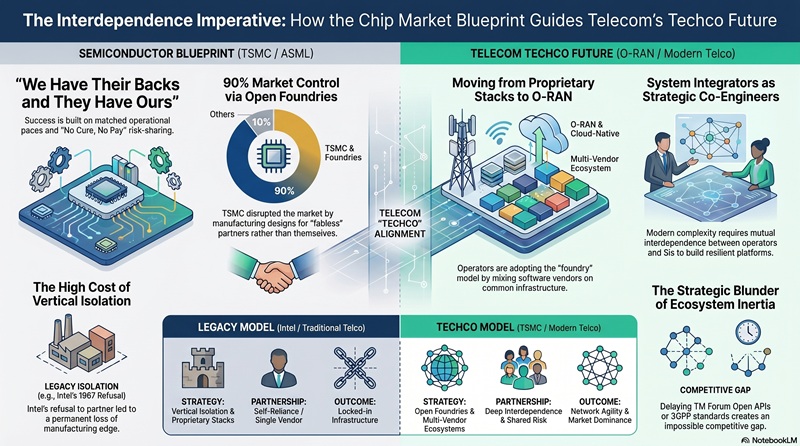
The collaboration between ASML and TSMC has revolutionized the chip market, which now controls 90% of advanced chip manufacturing. We witnessed the global impact during the COVID-19 pandemic when production slowed in Taiwan. Currently, the chip market is dominated by TSMC, representing one of the most significant success stories in the technology world today.
However, this success is rooted in several strategic partnerships formed between 1984 and 1990.
The story began when Philips was struggling to make its Wafer Stepper competitive in the market. Seeking a significant technical edge, they approached ASM International. While ASM International was initially hesitant, the leaders of both companies eventually agreed to join forces. They established a joint venture called ASML, with both parties investing funds to pursue their mutual interests.
Later, ASML required a high-end optical system—the heart of any lithography machine—to build truly competitive chips. They initially looked to Nikon and Canon, but those companies were unwilling to assist a potential rival. ASML then turned to the German company Zeiss, renowned for its optics. Together, they built the first truly competitive wafer stepper using lenses provided by Zeiss.
Philips, an early investor in ASML, partnered with Siemens on a “Mega Project” to challenge Japanese dominance in chip technology. Although the project faced significant losses, it cultivated expertise that would later prove invaluable. During this time, Morris Chang—after being turned away by Intel, Texas Instruments, and Japanese manufacturers—approached Philips seeking investment and support for his new venture, TSMC.
Philips took a 28 percent stake in TSMC and shared the expertise gained from the Mega Project. This partnership opened doors for ASML to place its machines on TSMC’s factory floors. While Chang was initially skeptical of ASML’s quality, he was eventually convinced by Wim Troost. The two companies proved to be remarkably like-minded, operating with a shared speed and intensity. They became totally interdependent, with the mantra “We have their backs and they have ours” becoming the formula for market dominance. Philips gradually reduced its stake in TSMC over the years, earning billions. In 2006, Philips exited the semiconductor market entirely by divesting its NXP division. Now an independent leader, NXP became a major supplier to the automotive industry. Through close collaboration with ASML, TSMC pushed new technology at breakneck speeds, turning Taiwan into the world’s primary supplier of advanced computing power. Intel, having declined to partner with Morris Chang in 1987, eventually lost its manufacturing edge to TSMC.
Lessons from the Chip Market Partnership
This history serves as a masterclass in the strategic dynamics of the semiconductor industry. It illustrates how a revolutionary business model, paired with high-stakes collaboration, reshaped global technology leadership.
Key lessons on collaboration and partnerships derived from this story are broken down into two focal points:
- Collaboration Learnings That Drive Growth in the Chip Market
- Interdependence Breeds Market Dominance (“We have their backs and they have ours”): The partnership between TSMC and ASML succeeded because of their symbiotic relationship. Their corporate cultures and operational paces matched perfectly. Growth occurs when both entities realize they are entirely dependent on each other for success.
- Risk-Sharing and Trust (The “No Cure, No Pay” Strategy): To establish a partnership with the demanding Morris Chang, ASML absorbed the initial risk by providing the first machine for free. In deep-tech collaborations, proving capability and building trust through shared risk is often the catalyst for long-term alliances.
- The “Foundry + Fabless” Ecosystem Shift: TSMC’s model was built on a collaborative premise: producing designs for other companies rather than their own. As manufacturing became too complex for individual firms, TSMC created a haven for “fabless” chipmakers, allowing the entire industry to innovate faster.
- Resilience Through Crisis: When a fire devastated a TSMC factory in 1988, ASML’s immediate support and shipment of replacement machines allowed for a rapid recovery. True growth is sustained when partners prioritize each other during catastrophic bottlenecks.
- Learnings from Those Who Missed Out (Intel & Philips)
- Intel (The Blind Spot of Self-Reliance): By refusing to partner with TSMC in 1987, Intel chose vertical isolation. Decades later, this lack of ecosystem collaboration caused Intel to lose its manufacturing edge to TSMC’s massive network.
- Philips (Trading Dominance for Liquidity): While Philips initially enabled the ecosystem, they steadily divested for immediate financial gains. They chose short-term capital over a permanent, foundational role in the global digital economy.
Key Takeaways for Telecom
The Evolution from Vertical Isolation to Open Ecosystems
The Semiconductor Lesson: Historically, legacy chipmakers like Intel relied on a vertically integrated model, designing and manufacturing everything in-house. TSMC disrupted this by introducing the “Open Foundry” model, focusing entirely on manufacturing chips designed by other “fabless” tech companies.
The Telecom Alignment: This directly mirrors the modern shift from proprietary, single-vendor legacy stacks to disaggregated architectures. When you state that operators rely on O-RAN, the Telecom Infra Project (TIP), and open-source communities, you are describing the telco version of the foundry model. Operators are breaking down vendor lock-in, using open blueprints to mix and match software from various solution vendors on a common cloud infrastructure.
Cultural Symbiosis and the Role of Integrators
The Semiconductor Lesson: The global chip market is not dominated by one company, but by a deep symbiosis between TSMC and ASML. They operated at a matching, breakneck pace, explicitly stating, “We have their backs and they have ours,” to manage extreme technical complexity and shared operational risks.
The Telecom Alignment: This explains why System Integrators (SIs) are so critical to your statement. Moving to an open, multi-vendor network skyrockets architectural complexity. Operators cannot manage this in a vacuum; they require SIs to act as strategic co-engineers. Much like the TSMC-ASML alliance, the operator-SI relationship is built on mutual interdependence—stitching together Linux Foundation codebases, TM Forum APIs, and vendor software into a resilient, unified platform.
The Catastrophic Cost of Ecosystem Inertia
The Semiconductor Lesson: In 1987, Intel had the opportunity to partner with Morris Chang but chose to stay on the sidelines, confident in their self-reliant model. Thirty years later, that single missed ecosystem window caused Intel to lose its manufacturing edge, a gap that became impossible to close.
The Telecom Alignment: This is a stark warning for operators who are slow to adopt unified industry standards like TM Forum’s Open APIs or 3GPP specifications. Rejecting or delaying deep collaboration with these community bodies today is not a minor IT delay—it is a long-term strategic blunder. Operators who isolate themselves will find it mathematically and operationally impossible to compete with the network agility and monetization capabilities of fully collaborative “Techcos.”
Playing the Long Game vs. Short-Term Liquidity
The Semiconductor Lesson: Philips was an early catalyst for the chip ecosystem, taking a massive stake in TSMC and opening doors for ASML. However, they slowly divested their stakes for immediate multi-billion-dollar payouts, completely exiting the semiconductor market by 2006 and surrendering long-term dominance.
The Telecom Alignment: This highlights how operators must approach their transformation partners. Collaboration with bodies like the GSMA, TM Forum, or cloud vendors should not be treated as a short-term, CapEx-slashing exercise. If operators treat these partnerships merely as a way to cut immediate IT costs rather than a vehicle to build a permanent, API-driven Network-as-a-Service (NaaS) platform, they risk pull-out dynamics similar to Philips—sacrificing their future seat at the table of the digital platform economy for short-term balance sheet relief.
Summary
The modern telecom operator’s reliance on solution vendors, system integrators, and bodies like the O-RAN Alliance and TM Forum is not unprecedented. It mirrors the evolution of the semiconductor industry. Just as TSMC and ASML forged an interdependent ecosystem that dismantled vertical monopolies, today’s “Techco” transformation requires a departure from legacy isolation. History warns that treating collaboration as optional leads to a loss of competitive edge. For telecom operators, deep integration with standards bodies and system integrators is the baseline for survival in a cloud-native world.
For telecom operators, as we witness significant investment in AI infrastructure from leaders like Deutsche Telekom, Orange, SK Telecom, Bharti Airtel and Jio, a new ecosystem template is emerging. It will be fascinating to see how operators leverage this next wave of innovation.


Be First to Comment