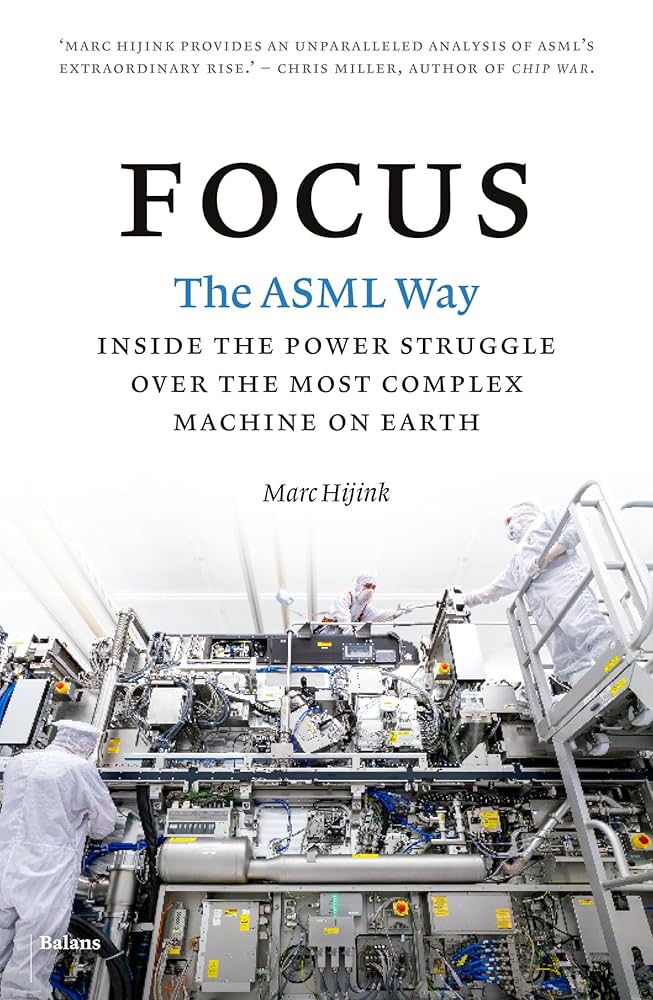
I recently finished reading five of the six sections of ‘Focus the ASML Way’, a book detailing the inner workings of the world’s most complex machines—the lithography systems that have enabled the global semiconductor market to dominate the tech landscape, much like TSMC’s pivotal
role. Gaining an inside look at ASML was an incredible experience, and it has made current real-world news feel far more significant as I observe the company’s profound impact on our future.
The headlines this past weekend were impossible to ignore: Elon Musk has officially become the world’s first trillionaire following the historic SpaceX IPO. SpaceX completed the largest stock market debut in history, listing on the NASDAQ at $135 per share. Investor enthusiasm drove the stock up nearly 20% by the close of its first day, pushing the company’s valuation past the $2 trillion mark.
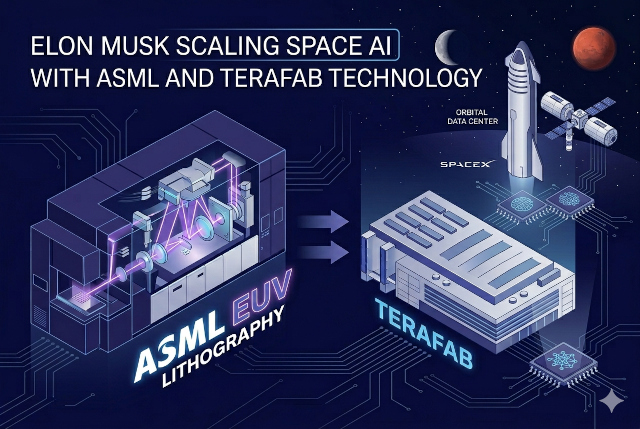
A central driver for this monumental IPO is Terafab, the massive, custom-built semiconductor factory announced by Musk in March 2026. This collaborative venture between SpaceX, Tesla, and xAI is designed to produce unprecedented volumes of high-end AI chips. Musk has made it clear that to achieve the necessary scale and performance—specifically regarding 2-nanometer process technology—the project must integrate ASML’s advanced machinery.

The chips produced by Terafab are intended to provide the massive computing power required for orbital AI data centers, which will ultimately support research and operations on other planets. With new satellite projects aiming to demonstrate space-based AI computing infrastructure as early as 2027, the long-term vision is clear: by leveraging the power of Starship rockets and harnessing solar energy on a grand scale, SpaceX is positioning itself to become the backbone of a super-advanced, multiplanetary civilization.
My Take
One important observation is that advanced chips are at the heart of innovation across almost every industry. Whether it is artificial intelligence, autonomous systems, robotics, or even the ambitious space initiatives being discussed by Elon Musk, all of them require an extraordinary amount of computing power.
Companies are now pushing the boundaries of semiconductor manufacturing, aiming to produce chips at the 2-nanometer scale. Achieving this level of precision is remarkable and demonstrates how far the industry has progressed. While it is difficult to predict how quickly these goals can be achieved at scale, the pace of innovation certainly appears optimistic.
When discussing the semiconductor ecosystem, most conversations focus on companies such as Nvidia, TSMC, and other chip designers and manufacturers. However, an equally important part of the value chain is often overlooked: the companies that build the machines used to manufacture these advanced chips.
This is where ASML stands out. There is no other company quite like ASML in the semiconductor industry. (China’s quest for similar is ON.) While technology enthusiasts closely follow the AI boom, rising compute demand, and concepts such as Moore’s Law, many are less familiar with the critical role ASML plays in enabling these advancements.
ASML’s development of Extreme Ultraviolet (EUV) lithography machines is one of the most significant engineering achievements of our time. These systems make it possible to manufacture chips at extremely small process nodes, including the cutting-edge technologies that are driving today’s AI revolution. The precision required is almost unimaginable and represents decades of scientific and engineering innovation.
Looking ahead, it will be fascinating to see how companies building the next generation of AI infrastructure, autonomous systems, and space technologies leverage ASML’s lithography capabilities. The future of computing and innovation remains incredibly exciting.







Be First to Comment