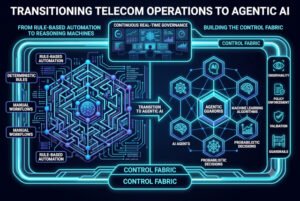
AI agents are about to bring real autonomy to telecom networks, and the Nokia-Google collaboration is a great example of where this is headed.
Together, they’re showing how telecom operators can move beyond manual troubleshooting by embedding AI agents directly into Nokia’s software. The result: networks that can automatically triage issues and fix them dramatically faster than before.
This also reveals a broader trend, network solutions vendors are keeping hyperscalers firmly in the telecom game through AI agents. Google Cloud, for instance, has built a rich ecosystem around Gemini, putting a powerful LLM at the disposal of network operations through purpose-built agents.
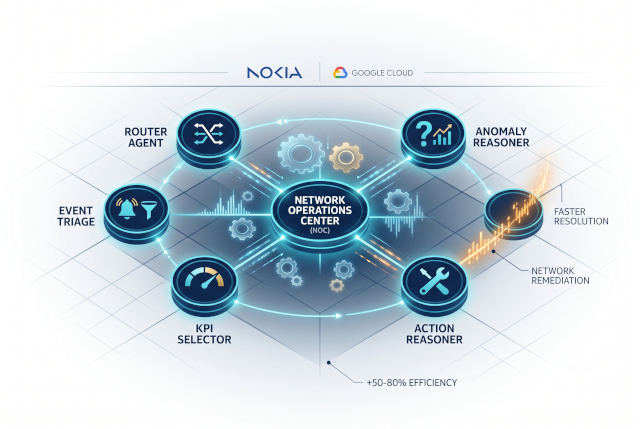
The architecture itself is worth understanding. A router agent acts as the central orchestration layer. An event triage agent analyzes ongoing alarms. A KPI selector agent supports reasoning by functioning as a network performance domain expert. An anomaly reasoner agent separates real issues from false alarms. An action reasoner agent recommends remediation steps. And a dashboard agent ties it all together for visibility.
This also reinforces how critical platforms are becoming for operators trying to manage innovation at scale. I’ve written before about the wave of platforms emerging around AI, and true to form, yet another platform is now stepping in, this time to manage the agents themselves. Nokia plans to launch its agentic platform on Google Cloud Marketplace in September. At that point, operators will be able to deploy the router and event triage agents through the Nokia Assurance Center, with the remaining four agents rolling out via subsequent software updates.
What’s particularly interesting is Nokia’s continued commitment to the “glass-box approach” rather than leaning entirely on AI systems that depend solely on learning from historical data. Renata Silva, head of Nokia’s Autonomous Networks Business, made the point that telecom networks haven’t evolved much under a purely machine-learning-driven, black-box model. AI agents, by contrast, are far better suited for reasoning through complex actions, and because they can explain their conclusions, they earn significantly more trust from the people relying on them.
The numbers back this up. Nokia claims these agents can cut network problem-solving time by 50 to 80 percent, directly reducing costly downtime and operational expenses. Effectively, the cost of manual troubleshooting is being replaced by the cost of tokens consumed by AI-driven agents, and the trade-off looks favorable: less time, lower cost, faster resolution.
This feels like an early but meaningful glimpse into what autonomous networks will actually look like in practice.


Be First to Comment