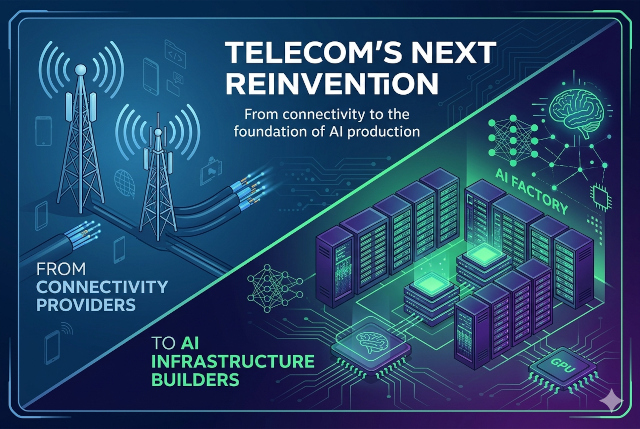
In 2018, while American telecom debated standards, China quietly launched 5G and rewrote the rules of telecom leadership. In 2026, history is repeating itself — this time the prize isn’t spectrum or base stations, but AI factories, and once again, China is moving first.
I wrote about this shift a year ago, when I argued that AI factories were becoming the new shape of telecom infrastructure — that the story was no longer about telcos as “connectivity providers,” but about telcos becoming the infrastructure for intelligence itself: the places where countries and industries will actually produce AI. I didn’t expect it to materialize this fast.
The United States has long been the foundational innovator in telecommunications, having invented most of the defining technologies of the last several decades. But that leadership story has aged. China saw the opportunity in 5G and seized it, becoming one of the earliest operators to launch commercially, around 2018. Much of that breakthrough traces back to Dr. Wen Tong of Huawei, the architectural mastermind behind Huawei’s 5G research program, whose work on Polar Codes helped push downlink speeds to 27 Gbps. That leap gave Chinese telecom operators an early, decisive advantage — and positioned China as the innovation leader of that entire technology cycle in telecom domain.
Now, nearly eight years later, AI has disrupted the industry again, this time with computing demands of an entirely different scale. A global wave of infrastructure-building is underway. Hyperscalers, semiconductor companies, and data center operators like Digital Realty, Equinix, and QTS are racing to dominate the AI infrastructure market, powered by chips from Nvidia and Intel.
And once again, China looks positioned to be the disruptor and trendsetter.
China’s Support to Telecom Operators for AI Infrastructure
While Western markets are still debating who should fund AI infrastructure, China has already answered the question. Reports indicate Beijing plans to commit roughly $295 billion toward AI data center buildout — and notably, the execution isn’t being left to hyperscalers or private capital alone. China is routing this investment through its telecom operators, with China Telecom and China Mobile positioned to operate the AI data centers themselves, while Huawei supplies the compute backbone through its chip technology.
This isn’t a new playbook for China. It’s a familiar one, executed again. The same state-backed conviction that pushed Chinese operators to launch 5G commercially years ahead of much of the world is now being redirected toward AI infrastructure. China isn’t just building data centers; it’s reinforcing a strategic pattern: when a new computing paradigm emerges, give telecom operators the capital and mandate to own the infrastructure layer, rather than ceding it to outside players.
For an industry watching this from the sidelines, the signal is hard to miss. China is demonstrating, in real time, what it looks like when a government treats AI infrastructure as critical national infrastructure — and treats telecom operators as the natural builders of it.
The Telcos Already Moving
The pattern visible in China is no longer isolated — it’s spreading across Asia and into Europe, with operators racing to claim a position in AI infrastructure before the window closes.
SoftBank was an early mover, breaking ground on an AI data center in Sakai back in 2024. Commercial operations are now slated to begin by the end of 2026, built around a joint deployment with OpenAI.
SK Telecom has gone further than most, treating AI infrastructure not as a side bet but as core strategy. The operator is building a national-scale AI Factory in Ulsan featuring more than 50,000 NVIDIA GPUs and a 100 MW data center — explicitly positioned as a hub for industrial AI, digital twins, and AI agents. SK Telecom has also partnered with NVIDIA to deploy the DSX platform within an AI cloud service planned for 2027.
In India, Reliance Industries is taking a different but equally telling approach: building a massive, built-to-suit AI data center in Jamnagar in partnership with Meta. Reliance will design, build, and operate the facility, while Meta leases the capacity and absorbs the full operational cost of energy and water — a model that signals how hyperscalers and telecom-adjacent conglomerates are beginning to split infrastructure risk.
Elsewhere, Japan’s NTT Data and KDDI, along with Singapore’s Singtel, are each developing their own AI data center capabilities, suggesting this isn’t a China-only or even Asia-only phenomenon, but a structural shift across the region.
And in February 2026, Deutsche Telekom claimed a notable first: launching what is being called the first fully operational AI Factory, built in Munich alongside NVIDIA and data center partner Polarise. Other European operators — Telefónica and Orange among them — are now investing aggressively to avoid being left behind.
My Take
Telecom operators are standing at a familiar but uncomfortable crossroads.
For the last two decades, the rise of cloud computing forced operators into a single, relentless mandate: deliver more bandwidth, faster. That mandate took them from 2G to 3G to 4G, and now into 5G — a generation finally capable of supporting digitalization, enterprise transformation, and AI-native applications at scale. Even as the industry begins talking about AI-native 6G, most operators are still mid-journey on 5G, still absorbing the capital intensity of the last upgrade cycle.
This is precisely why AI infrastructure matters right now. It isn’t just another technology wave for operators to support — it’s a monetization opportunity and an identity opportunity arriving at the same time. Telecom operators have spent years being boxed into a single category: connectivity provider. AI infrastructure offers a way out of that box. It gives operators a credible path to becoming infrastructure providers and technology enablers — not adjacent to the AI economy, but foundational to it.
And the assets line up. Telecom operators already hold what AI infrastructure needs: extensive network footprints, edge locations, regional presence, and deep relationships with enterprises, governments, and institutions. Few other industries enter this race with that combination already built.
The harder truth is that the window to monetize AI compute may not stay open indefinitely. Owning and operating AI infrastructure now, while the market is still being defined, is likely to matter more than owning it later, once the category matures and margins compress. China understands this. Its decision to channel investment through China Telecom and China Mobile, backed by Huawei’s chip capabilities, isn’t just an industrial policy choice — it’s a signal about what is coming next.
I believe that signal sets a precedent the rest of the world won’t be able to ignore for long. Governments elsewhere may not move as fast or as centrally as China has, but the underlying logic — telecom operators already possess the network assets, regional reach, and operational expertise to deploy AI infrastructure at scale — holds regardless of geography. The real difference isn’t capability. It’s funding. Chinese operators move with direct government backing; operators elsewhere are largely left to fund this transformation off their own balance sheets. Over time, I expect more governments to close that gap, encouraging collaboration between telecom operators, network vendors, semiconductor companies, and chipmakers to build what is increasingly being called sovereign AI infrastructure.
That word — sovereign — is doing more work than it might first appear to. Governments and enterprises are no longer just asking who can build AI infrastructure; they’re asking where that infrastructure sits, whose jurisdiction it falls under, and whether their data and models stay within national or regional boundaries. This single concern — digital sovereignty — may end up being the strongest argument yet for telecom operators to lead, since they already operate as regulated, in-country entities in a way most hyperscalers don’t.
None of this comes cheap. Building AI factories means absorbing massive capital expenditure: GPU-dense infrastructure, high-performance networking, energy-intensive facilities, and hyperscale-grade data centers. That capital burden is real, and it will determine who survives the next phase of this race and who doesn’t.
But here is the larger shift I want readers to sit with: telecom operators are no longer just building networks. They are positioning themselves to become the operators of national-scale compute — the foundation on which entire economies will run their AI. We are watching telecom operators evolve, in real time, from connectivity providers into TechCos. And TechCos, not connectivity providers, are who will define the next era of this industry.




Be First to Comment