Last updated on July 17, 2026
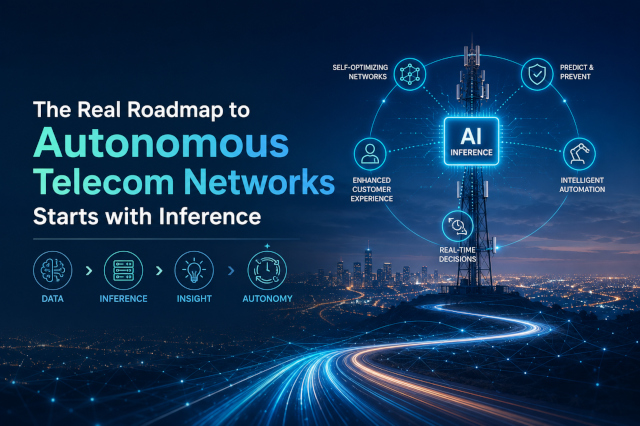
There is no shortage of optimism when it comes to AI and telecom. And rightly so. For telecom networks, AI points toward something genuinely transformative — TM Forum’s Level 4 autonomous network, a state where network systems can independently reason, decide, and act across multiple domains, without waiting for a human to intervene. But getting there is not a single leap. It is built on something more specific: AI inference running inside the network itself. Across thousands — and eventually millions — of network components, trained models are making real-time decisions that keep the network alive, efficient, and responsive. That is the engine underneath the autonomy story.
So where is this inference actually happening today? And where is it headed? Here is a clear-eyed look at both.
Where AI Inference Is Happening in Telecom Networks Today
AI inference has moved from the lab into live network operations — but unevenly. It is mature and production-grade in some layers, and still experimental in others.
- RAN baseband — beamforming, channel estimation, and link adaptation now run on learned models, replacing fixed algorithms
- Near-RT RIC (xApps) — real-time traffic steering, interference management, and mobility control
- Non-RT RIC (rApps) — longer-horizon policy generation and model retraining inside the SMO domain
- NWDAF (5G Core) — mobility prediction, QoS optimisation, and anomaly detection
- AIOps / fault management — predictive maintenance and root-cause analysis, already cutting major faults by up to 80% and saving over a billion kilowatt hours of electricity
- SMO orchestration — intent-based, zero-touch network configuration
- Cell-site GPU compute ("AI Grid") — general-purpose inference co-located at towers for vision, voice, and robotics workloads
- MSO / Central Office compute — regional inference hosting at network data centres
- Device / CPE edge — on-device vision-language models for real-time, connectivity-free inference
- The core pattern: AI running the network — through RIC, Core Functions, and AIOps — is mature and delivering measurable results. AI running on the network as general- purpose compute, what the industry is calling the "AI Grid," is still a bet, not yet a proven business.
Where AI Inference Will Happen Next
The next wave moves inference from sitting beside the network to being woven into the waveform itself — and from reactive optimisation to genuine, agentic decision-making.
- Air interface itself — two-sided AI models split inference across device and base station simultaneously for CSI compression (3GPP standard, 2026–27)
- AI-driven mobility — learned models replace rule-based handover logic entirely
- Integrated Sensing & Communication (ISAC) — the RAN becomes a sensor, inferring object position, motion, and material composition — a new revenue category beyond connectivity
- Ambient IoT — inference pushed to battery-free, energy-harvesting silicon at the extreme edge
- NTN / satellite — inference moves off terrestrial infrastructure entirely for GNSS- resilient positioning
- Uplink-heavy multimodal inference — new compression layers required as XR and agentic traffic inverts today's downlink-dominant pattern
- Network digital twins — continuous AI simulation of the live network before any configuration change is deployed
- Agentic AI layer — LLMs that decide what to optimise, not just execute one model (already in production at SoftBank and Deutsche Telekom)
- Physical AI / robotics control loop — RAN, edge, and device inference fused into one closed loop for AVs, drones, and smart manufacturing
The shift: inference moves from sitting beside the network to being woven into the waveform — and from reactive optimisation to autonomous, agentic decision-making.
What This Means for Integrators, Operators, and Solution Vendors
The technology roadmap is one thing. What you actually do with it is another. Here is a practical read for the three groups shaping this space.
If you are a System Integrator
Stop chasing the model. Chase the mess in between. Every operator will eventually have a tangled architecture of RAN components, core network functions, and emerging agentic AI tools from different vendors that do not talk to each other cleanly. That integration challenge — not the AI itself — is where the real, durable work lives. The opportunity is in building the connective tissue: the knowledge layers, data pipelines, and orchestration frameworks that turn a collection of point solutions into something that actually functions as an autonomous network.
Digital twins are no longer a future concept either — they are moving into the network now. Integrators and solution vendors who build reusable IP and frameworks around these layers will be ahead of the curve, not catching up to it.
If you are a Telecom Operator
Be deliberate about which bets are safe and which ones are speculative — and invest in each accordingly.
Running the network with AI — fault detection, energy savings, self-healing — is proven. It is already saving real money. Putting GPUs at every cell tower for general-purpose AI hosting is not proven yet. It is a bet on a business model that does not fully exist. Do not fund both with the same confidence.
The journey toward TM Forum Level 4 autonomous networks is the right destination, but it requires careful, staged steps. AI infrastructure will demand increasing attention and capital — the operators who plan that transition deliberately, rather than reactively, will be better positioned when the inflection points arrive.
If you are a Network Solution Vendor
The architecture debate is still open — and that is both a risk and an opportunity. GPU-everywhere (Nokia/NVIDIA) versus custom-silicon (Ericsson) is not settled. Operators are visibly hedging, which means vendors who make procurement easy to revisit — through interoperable, portable solutions — will earn more trust than those who push for lock-in. The vendors who move first toward full-stack, fully trusted solutions, rather than impressive point capabilities, will define the reference architectures that everyone else builds around.
The Bigger Picture
The telecom network is becoming something that senses, reasons, and decides — not just something AI rides on top of. That shift is already underway in the operations layer, and it is moving steadily toward the waveform itself.
The winners across all three groups will not be the ones with the most impressive model. They will be the ones who build the trust, orchestration, and integration layer that holds the whole system together — and who understand that the path to Level 4 autonomy runs through every component, from the baseband unit to the agentic AI sitting above the core.

Be First to Comment