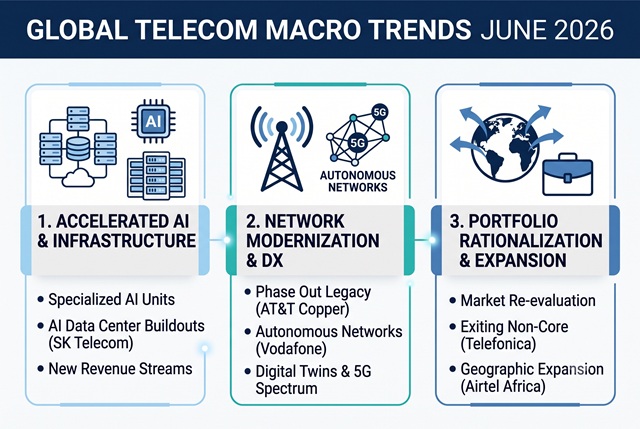
The global telecom market in June 2026 was characterized by significant strategic shifts, particularly a strong push into AI infrastructure and services, alongside ongoing efforts to modernize core networks. Major operators grappled with financial pressures, as evidenced by tumbling stock prices for some US incumbents, even as others like SoftBank and SK Telecom announced multi-billion dollar AI-centric investments. Simultaneously, regional players like Telefonica streamlined portfolios, while others like Bharti Airtel expanded their footprint in emerging markets, signaling a diverse set of responses to evolving market demands.
Top 3 Macro Industry Shifts
- Accelerated AI Integration and Infrastructure Investment: Telecom operators are making substantial commitments to AI, ranging from establishing specialized AI units and developing AI models (China Mobile, SoftBank) to planning massive AI data center buildouts (SK Telecom). This signifies a pivot towards leveraging AI as a core strategic differentiator and a major new revenue stream, moving beyond traditional connectivity services.
- Network Modernization and Digital Transformation: There’s a clear global trend towards phasing out legacy infrastructure, such as AT&T’s efforts to divest copper services, while simultaneously investing in next-generation technologies like autonomous networks (Vodafone), digital twins (NTT Docomo), and advanced 5G spectrum (NTT Docomo). This dual approach aims to enhance network efficiency, reduce operational costs, and support the burgeoning demand for high-speed, low-latency connectivity.
- Strategic Portfolio Rationalization and Geographic Expansion: Operators are strategically re-evaluating their market presence, with some like Telefonica exiting non-core regions to focus on key European markets, while others like Bharti Airtel are aggressively increasing stakes in high-growth areas such as Africa. This indicates a focus on optimizing global portfolios for better profitability and market dominance, either through consolidation or targeted expansion in promising geographies.
Operator-by-Operator Strategic Review
| Operator | Monthly Trend Summary |
| AT&T | Focused on divesting legacy copper infrastructure and expanding home broadband options, while experiencing stock market volatility alongside peers. |
| Verizon | Faced stock market challenges and questions about execution, while also making a significant payment to BT and engaging in World Cup advertising and regulatory waivers. |
| T-Mobile US | Experienced stock decline and was highlighted for its 5G scale, amidst discussions about potential competitive shifts in the US market. |
| China Mobile | Established a token office to scale AI services and contributed to the shift towards ‘digital’ and ‘intelligent’ towers. |
| Vodafone | Expanded its African presence through the Safaricom deal and partnered with Spotify in India, while also collaborating on autonomous network frameworks. |
| Orange | Unveiled a new strategy for its Romanian subsidiary, with analysts viewing its stock as stable. |
| Telefonica | Initiated plans to exit Mexico to increase focus on European markets, faced consultation on wholesale access fees, and explored AI-driven 5G pushes. |
| NTT Docomo | Won a key 5G spectrum auction in Japan and showcased leadership in automated networks, digital twin technologies, and IOWN trials. |
| SoftBank | Gained FCC approval for a key acquisition (WOW!) and led Japan’s significant investment in AI models, underscoring its AI-centric strategy. |
| Telstra | Demonstrated resilience in its shares despite market pullbacks and participated in a new mobile coverage map standard initiative. |
| Bharti Airtel | Significantly increased its stake in Airtel Africa, solidifying its grip on the African telecom market and receiving positive analyst ratings. |
| Reliance Jio | Prepared for a record-breaking IPO (Project Jupiter) and continued expanding its home broadband connections in India. |
| China Telecom | Contributed to China’s fiber-optic capacity records, shifted to intelligent towers, and launched a competitive new AI product. |
| Deutsche Telekom | Received an award for network solution implementation and expanded its roaming bundles for family packages, while its stock remained in focus. |
| Singtel | Reported record profits but saw a reduction in CEO pay, indicating a focus on cost management despite strong performance. |
| SK Telecom | Announced an ambitious plan for a 15GW AI data center buildout, acquired a stake in SK Hynix NAND, published a cybersecurity white paper, and launched esports initiatives, emphasizing a major pivot to AI and data infrastructure. |


Be First to Comment