RAN is the component where telcos face their toughest constraints — cost, energy, and performance all collide here. That’s exactly why telecom leaders have been looking to AI to make a real difference at the RAN level.
Deutsche Telekom has already set a landmark for the rest of the industry with its RAN Guardian agent, which paired agentic AI with the radio access network for the first time. RAN Guardian was DT and Google Cloud’s first multi-agentic AI system, launched and discussed on the same stage a year earlier. It was built to solve one specific problem: keeping the network running smoothly during public events and gatherings — concerts, sports matches, festivals — where demand spikes hard and fast. I wrote earlier about RAN Guardian last year when it first launched. This year at MWC 2026, DT and Google Cloud came back with its successor.
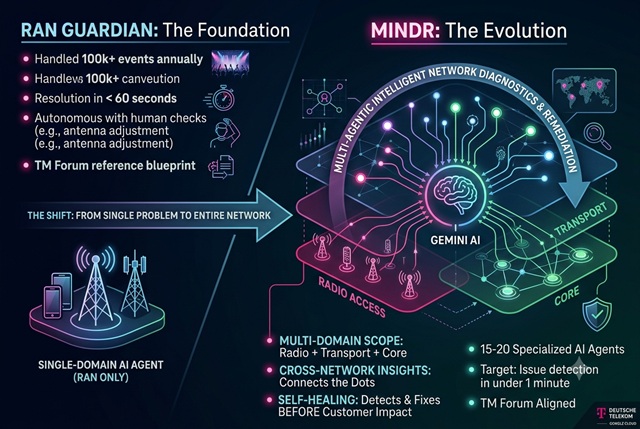
At MWC 2026, the two companies unveiled MINDR (Multi-agentic INtelligent Network Diagnostics and Remediation). With MINDR, DT is signaling a clear shift: from solving one problem in one part of the network (RAN Guardian) to running an intelligent system across the entire network — radio, transport, and core — with one ultimate goal: a network that heals itself, and does it at the speed AI moves, not the speed telcos have traditionally moved at.
How RAN Guardian delivered on its promise
Before we get to MINDR, it’s worth pausing on just how much RAN Guardian already changed for DT.
- A hundred times more events, covered. Before RAN Guardian, DT could realistically manage around 1,000 public events a year. Today, there’s practically no ceiling — DT is handling more than 100,000 events annually. That’s not a small improvement; it’s a different order of magnitude.
- This isn’t about saving money — it’s about doing something new. DT has been careful to frame this as a leap in capability, not a cost-cutting exercise.
- From days to under a minute. Spotting a problem, understanding it, and fixing it used to take days. Now it happens in under 60 seconds.
- Autonomous, but not unsupervised. The agents genuinely operate on their own — watching, diagnosing, and fixing issues without waiting for a human to tell them what to do. But for actions with real-world consequences, like physically adjusting a radio antenna’s angle, a human still checks and approves the move.
- Built to be shared, not kept. RAN Guardian runs on Google Cloud and follows an autonomous network framework that TM Forum, the industry’s standards body, has since adopted as a reference blueprint — meaning any operator can build on the same foundation.
What’s perhaps most telling is how other operators reacted. Ahmed Hafiz of DT shared, in a panel discussion at MWC 2026, that competitors didn’t come asking for the “secret sauce.” They came asking, “how did you dare to do that?” It’s a small line that says a lot about how nervous the industry still is about handing real decisions to AI. DT’s answer was to move carefully: even when no human was watching in real time, the agents were boxed in so tightly that they simply couldn’t do anything harmful. And the biggest win from RAN Guardian, according to both DT and Google Cloud, wasn’t even the performance numbers — it was how it changed the way DT’s own teams think about running an autonomous network. That shift in mindset is what made MINDR possible.
Introducing MINDR
What the name means: MINDR stands for Multi-agentic INtelligent Network Diagnostics and Remediation. Fittingly, “Minder” also just means someone — or something — that watches over and protects, a nod to the guardian role it plays across DT’s network.
What it actually does: Think of MINDR as a system with two jobs. First, it watches everything happening across the network and makes sense of what it sees. Second, when something goes wrong, it doesn’t just flag the problem — it traces it back to the root cause and fixes it, often before a customer ever notices anything was wrong.
What makes MINDR a genuine leap forward from RAN Guardian is scope. RAN Guardian solved one problem in one part of the network. MINDR works across radio, transport, and core simultaneously, and the team behind it has already mapped out more than 15 different use cases it can handle — with only three shown publicly so far. The demo video DT showed on stage promised networks that are “fast, reliable, invisible” — and, notably, DT was clear that what was on screen was the real product interface, not a mockup.
What’s powering it, in plain terms:
- A trusted way to build and run AI agents. Google Cloud thinks of these agents almost like employees — they need identities, permissions, and security controls, the same way a person would.
- Gemini as the brain. Google’s Gemini AI model does the heavy lifting of understanding what’s happening across every part of the network — the devices connecting to it, the traffic moving through it, and the infrastructure carrying it all.
- A shared, connected view of the data. All the different logs, metrics, and signals from RAN, transport, and core get pulled into one place, so the system can connect the dots across parts of the network that never used to talk to each other. Google Cloud is also working with T-Systems on next-generation techniques to make these cross-network connections even smarter over time.
How it’s engineered under the hood: MINDR isn’t one AI model — it’s a team of them. Somewhere between 15 and 20 specialized agents are already running, each handling a different job, and DT keeps adding more as new needs arise. Simpler, routine tasks get handled by fast, lightweight AI models, while the harder problems — the ones that require connecting clues across radio, transport, and core — get escalated to more powerful models built for deeper reasoning. Underneath it all, DT has put real engineering discipline into the details: how fast it runs, how much it costs, how accurate it is, and how well it keeps learning. As Ahmed Hafiz put it, getting this right isn’t a checkbox exercise — it’s where the real work lives, and it only succeeds if the operations teams on the ground genuinely trust and adopt it.
The targets and the timeline
DT isn’t being vague about what success looks like. The bar it set for itself previously was to detect issues within 15 minutes and resolve them within an hour. MINDR is aiming much higher: detecting issues in under a minute, and generating a root-cause analysis automatically in under five. Alongside that, DT wants to cut reliance on manual tools by 80% — not eliminate them completely, but make them the exception rather than the rule.
The rollout is already moving. A “co-pilot” version of MINDR — human-assisted rather than fully autonomous — is in development now and targeted to launch by April. From there, DT continues testing and expanding use cases through the year, working toward fuller autonomy by year’s end. Both DT and Google Cloud were candid that this pace is deliberate: telecom can no longer afford the slow, multi-year testing cycles it used to run. It has to move at the speed AI moves.
And this isn’t just a DT story. Maninder Singh Sambi of Google Cloud made the point directly: MINDR, and the framework behind it, is meant for any operator running a large network, not DT alone. It’s built to align with the same TM Forum autonomous network framework that the wider industry has already adopted as its reference architecture. Since RAN Guardian launched, DT and Google Cloud say the majority of major telecom operators have reached out — not just curious, but actively wanting to understand DT’s journey and adopt the same foundation for themselves.
A next leap, and an open door for the rest of the industry
With MINDR, Deutsche Telekom has taken the next real leap in what an autonomous telecom network can look like — moving from solving one problem well to running an entire network that watches, diagnoses, and heals itself, at a pace no telco has operated at before. It’s a genuine proof point, not a slide-deck promise: the interface shown on stage was live, the targets are specific, and the rollout has already started.
The bigger question now is what the rest of the industry does with the door DT and Google Cloud have deliberately left open. In the next article, we’ll look at exactly that — how other telecom operators are likely to take this same platform approach and build their own roadmaps on the template DT has just proven works.

Be First to Comment