Sovereign cloud is the hottest trend among telecom operators seeking future revenue from their national network infrastructure footprints. Nearly every tier-1 operator we recognise globally is already pursuing it in some form.
Orange, a leading tier-1 telecom operator, has taken a strategic step by acquiring Dome, the cloud-native software unit of French firm Obvios, for an undisclosed amount. The move strengthens the sovereign private 5G portfolio of Orange Business, the telco’s enterprise services division.
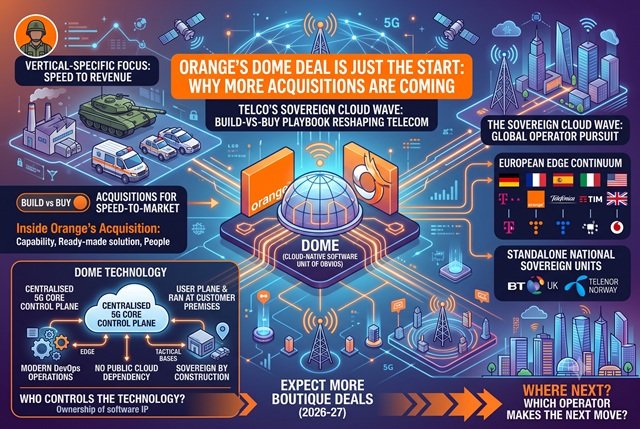
On the surface, this reads like a routine acquisition. I see it as something more: a trendsetter that highlights the global push toward digital sovereign cloud by operators serving critical sectors. Mainly, it confirms an already-running trend — vertical-specific, cloud-native tuck-in acquisitions in the sovereign/defence niche.
Vertical-Specific Focus: The Fast Track to Revenue
“Vertical-specific” here points to defence, public safety, and critical infrastructure — sectors that are the lowest-hanging fruit in the digital sovereignty wave. An acquisition like this signals an operator’s urgency for speed-to-market and faster revenue generation, rather than a slow, ground-up build.
Defence and critical-infrastructure connectivity is becoming its own acquisition sub-market. Nokia’s tactical 5G work with Latvia’s LMT for Baltic defence mirrors Orange’s Dome use cases almost exactly — military bases, contested and remote tactical networks. Expect more boutique “sovereign defence connectivity” deals like this one, distinct from the broader enterprise sovereign-cloud land grab.
Inside Orange’s Acquisition of Obvios’s Dome Technology
First, this is a capability acquisition, not simply a company or a product buy. Cloud-native expertise is difficult to build internally at speed. Along with the capability, Orange acquired a ready-made solution — technical know-how included — plus the people who built it.
Dome is a cloud-native software platform that enables the deployment of secure, resilient sovereign communications suited to critical environments. In essence, it’s a network software layer that sits between the physical and infrastructure layers. By acquiring this connecting layer, Orange gains greater control over the network. As TelecomTV described it, Dome is a centralised, cloud-based 5G core control plane connected to dedicated user-plane and RAN equipment at the customer’s premises.
That architecture — separating the control plane from the user plane — matters enormously for sovereign networks. The control plane can be centralised while the user plane and RAN sit at the enterprise or edge location. The one caveat worth flagging: the RAN/core hardware layer is still a vendor oligopoly, not a telco land grab. Acquiring Dome-like technology is a smaller, cheaper, and faster category of move than trying to build a full core-network vendor business from scratch.
Here’s another angle worth considering. Historically, “cloud-native 5G core” meant partnering with or reselling hyperscaler/public-cloud-anchored stacks — AWS, Azure, or vendor platforms like Ericsson or Nokia cores running on public cloud. But defence and critical-infrastructure customers explicitly cannot have their core control plane dependent on a US hyperscaler’s cloud region, for jurisdictional and continuity-of-service reasons. So, Orange needed cloud-native architecture — agility, automation, edge-deployability — without the public-cloud dependency that “cloud-native” usually implies. Dome, built and tested on Sylva, a Linux Foundation European open-source telco-cloud stack, gives Orange exactly that combination: modern DevOps-style operations, but sovereign by construction.
Normally, an operator can comfortably buy network technology from global vendors. But sovereign infrastructure raises a deeper question: who controls the technology? For a defense network, government network, or critical infrastructure, that question makes ownership of the underlying software IP strategically far more valuable. Where does the software run? Where is the data processed? Who controls the encryption? Who can update the software? Who has access to the infrastructure? Can the network operate independently, deployed without dependence on a foreign cloud? Dome is explicitly positioned around sovereign deployment, operational control, and resilience — which is precisely why it answers these questions well.
European Edge Continuum: A Coalition to Preserve Digital Sovereignty
Operators are now banding together regionally rather than going it alone. At MWC 2026, Deutsche Telekom, Orange, Telefónica, TIM, and Vodafone announced the European Edge Continuum — a federated, operator-run edge network designed to keep latency-sensitive, jurisdiction-sensitive workloads under collective European control. It covers roughly 55% of Europe’s population and targets use cases like transport logistics, industrial automation, and emergency services on local EU-based infrastructure. It’s a tacit admission that no single European operator — not even Deutsche Telekom — can out-scale AWS, Azure, or Google Cloud alone. Sovereignty is becoming a coalition play, not a national-champion play.
Layered on top of this, several operators are building standalone national sovereign units rather than folding sovereignty into existing product lines. BT launched a full UK sovereign portfolio — Sovereign Voice, Sovereign Cloud built on UK-based Rackspace infrastructure, and sovereign AI with Nscale/NVIDIA, all run by UK-based, security-cleared staff. Telenor announced it is spinning up Telenor Sovereign Cloud as a standalone Norwegian company, citing rising dependence on global hyperscalers as reason enough to build “nationally controlled cloud solutions.”
Conclusion
As I noted earlier, this acquisition confirms an already-running trend: vertical-specific, cloud-native tuck-in acquisitions in the sovereign/defence niche. It sits alongside — not in place of — the build-heavy strategy of operators like Deutsche Telekom, the coopetition-heavy strategy of AT&T and Telefónica with AWS, and the federation-heavy strategy behind the European Edge Continuum. These are all live playbooks running in parallel across the industry.
Expect more Dome-sized deals through 2026-27. Boutique cloud-native core and edge startups will keep making attractive tuck-in targets, precisely because they de-risk the “build vs. buy” decision for defence and critical-infrastructure verticals specifically.
Where do you think the next Dome-style acquisition will come from — and which operator makes the next move?





Be First to Comment