The telecom industry is now entering the era of Agentic AI. Whether it is autonomous network operations, intelligent optimization, or AI-driven business processes, the next wave of innovation is clearly underway. Before we get carried away by what AI can deliver, it is worth asking an important question:
How far have telecom operators progressed on the software-defined journey that started with SDN and NFV?
After all, SDN and NFV were introduced to make networks more open, flexible, and less dependent on a single vendor. They promised faster service delivery, lower operating costs, and greater freedom of choice. Today, as AI becomes deeply integrated into telecom networks, understanding how much of that vision has been realized is more relevant than ever.
Have operators really escaped vendor lock-in?
The short answer is not completely.
Industry data suggests that around 40–45% of telecom operators have achieved meaningful multi-vendor capability in at least one network domain. However, this does not mean they are completely free from vendor lock-in. In many cases, operators have diversified suppliers in one part of the network while remaining heavily dependent on a single vendor for orchestration, cloud platforms, lifecycle management, integration, or operational support.
This distinction is important. An operator may successfully run network functions from multiple vendors, yet still rely on one vendor’s management platform to operate the entire network.
Why didn’t SDN and NFV completely solve the problem?
SDN and NFV successfully separated network functions from proprietary hardware, reducing dependence on specialized equipment. But software portability is much more complex than hardware portability.
Vendor lock-in has gradually shifted to higher layers of the network stack, including:
- SDN controllers with proprietary APIs and policy models
- MANO and SMO platforms that become the operational control point
- Telco cloud infrastructure and Kubernetes distributions
- OSS/BSS integrations built around custom workflows
- Vendor-specific operational processes and support models
In other words, operators have reduced hardware dependency but introduced new software and operational dependencies. Standards such as ETSI NFV have improved interoperability, but compliance alone does not guarantee true plug-and-play integration across vendors. Extensive testing and customization are still required.
Where are operators today?
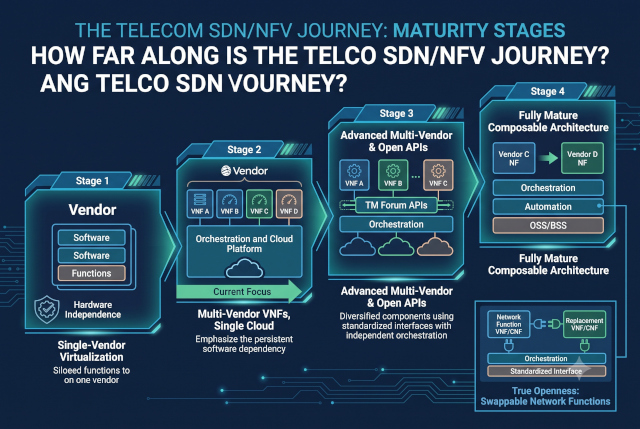
The industry’s maturity can broadly be viewed in four stages.
At the basic level, operators virtualize network functions but continue purchasing the complete software stack from a single vendor.
The intermediate stage allows operators to source VNFs or CNFs from multiple suppliers while continuing to rely on one preferred cloud platform or orchestration stack.
The advanced stage introduces open APIs, portable workloads, independent orchestration, and validated multi-vendor deployments.
Only a small number of operators have reached the most mature stage, where network functions, infrastructure, orchestration, and automation can all be replaced independently with minimal disruption.
Today, most telecom operators remain in the intermediate stage, particularly across 5G core, edge computing, and RAN automation. They have achieved supplier diversity in selected components, but true architectural portability remains limited.
What are leading operators doing differently?
Operators that are making the greatest progress share several common practices:
- Deploying independent orchestration platforms instead of proprietary vendor controllers
- Requiring standardized APIs and data models during procurement
- Adopting cloud-native network functions with proven portability
- Separating automation logic from vendor-specific device configurations
- Maintaining multiple certified suppliers for critical network functions
- Ensuring operational data, telemetry, and policies can be exported
- Conducting interoperability and failure-recovery testing before production deployments
Many operators are also embracing initiatives such as TM Forum Open APIs and Open Digital Architecture to build more modular and composable telecom systems. While these approaches improve flexibility, they do not automatically eliminate vendor dependency.
The bottom line
SDN and NFV have undoubtedly transformed telecom networks. They have significantly reduced hardware lock-in and created greater flexibility than legacy network architectures ever allowed.
However, the challenge has evolved rather than disappeared.
Today, vendor dependency exists primarily in software, orchestration platforms, cloud infrastructure, automation frameworks, operational processes, and data models. While nearly half of operators have achieved multi-vendor capability in parts of their networks, only a much smaller group can replace a core supplier without major operational and integration effort.
As the industry moves toward AI-native and autonomous networks, this distinction becomes increasingly important.
The real question is no longer whether an operator has deployed SDN or NFV.
The real question is:
Can the operator replace a vendor’s network function without rebuilding orchestration, automation, OSS/BSS integration, security, and operational processes?
That is the true measure of openness—and it will determine how quickly telecom operators can adopt the next generation of AI-driven networks.




Be First to Comment