AI Agents are having a moment. They’re being hailed as the technology that will transform everything — and telecom operations are no exception. Operators, vendors, and analysts alike are racing toward an “Agentic AI native” future for network operations.
Here’s the uncomfortable truth nobody’s saying loudly enough: as we move toward Agentic AI, complexity doesn’t disappear. It increases. And that increase won’t simply make life easier for network experts — at least not right away.
Let me explain why.
From Rule-Based Automation to Reasoning Machines
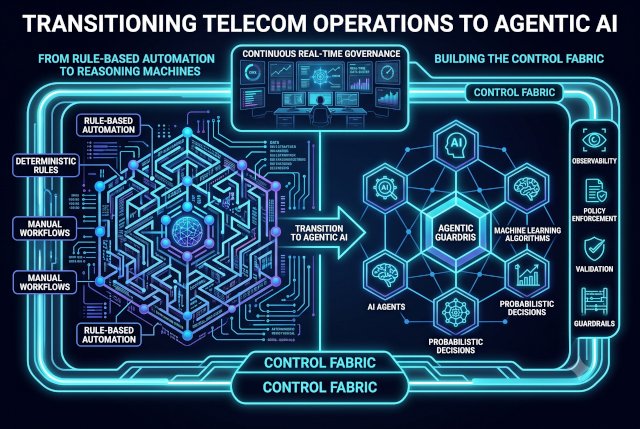
Automation has always existed in telecom networks. What’s changed recently is that automation, augmented by AI, has evolved into a “human-in-the-loop” model. In this architecture, engineers define the rules, workflows, and scripts — and the system executes accordingly. It’s deterministic. Predictable. If X happens, do Y.
AI Agents represent the next wave — and a fundamentally different kind of system. Picture agents embedded across every layer of telecom network operations: sensing conditions, planning responses, acting on decisions, and learning from outcomes. That’s the promise.
But here’s the catch: for agents to sense, plan, act, and learn reliably in a live network environment, they need a specific level of reliability, trust, and supporting infrastructure that simply didn’t matter in the rule-based world.
Why Agentic AI Breaks the Old Trust Model
Traditional automation was trustworthy because it was predictable — the same input always produced the same output. Agentic AI changes this equation entirely, because LLM-based systems are probabilistic, not deterministic. You cannot always predict exactly how an agent will arrive at a decision.
This is the crux of the challenge. It’s no longer just about building automation — it’s about building an environment of trust around inherently unpredictable decision-makers.
And the stakes are compounded by scale and speed. AI Agents can make decisions at machine speed, execute multiple actions simultaneously, and continuously interact with tools and systems across the network. But no human team can validate thousands — let alone millions — of such decisions at that same velocity.
This forces a fundamental shift: governance can no longer be a periodic human review process. It has to become continuous, real-time governance of machine-generated decisions.
The Real Shift: From AI Capability to AI Control
Today, most of the industry conversation is fixated on AI and LLM capability — how smart is the model, how well does it reason, what can it automate.
Going forward, the more durable enterprise capability won’t be the agent’s intelligence. It will be the infrastructure around it: control, validation, orchestration, observability, and governance.
This reframes the entire roadmap to autonomous telecom. The path isn’t:
“Better agents → more autonomy”
It’s:
“Better validation and control infrastructure → safely achievable autonomy”
In other words, autonomy isn’t unlocked by making agents smarter. It’s unlocked by building the systems that make it safe to let smart agents act.
Building the Control Fabric, Not Just the Agent
This is where ACL Digital’s approach comes in: helping operators build the control fabric around agentic AI — not just the AI agent itself.
By bringing together SDN, SD-WAN, SASE, ZTNA, test automation, OSS fulfillment & assurance, MDSO, infrastructure automation, AIOps, network security, and multi-vendor integration, ACL Digital helps operators build the cloud-native foundation needed to progress through the maturity curve:
AI-assisted operations → AI-augmented operations → controlled agentic operations → autonomous telecom operations
Each stage requires more than better models — it requires deeper observability, tighter policy enforcement, and infrastructure capable of validating decisions at machine speed.
The Bottom Line
The future of autonomous telecom won’t be defined by whichever agent is smartest. It will be defined by the infrastructure that makes that agent safe to trust.
The limiting factor in agentic AI isn’t model capability — it’s the ability to validate and govern decisions at the same speed and scale as the agents making them.
Operators that invest in robust agent harnesses — with strong observability, guardrails, backup and reversibility, and policy enforcement — will be the ones who turn promising AI pilots into production systems they can actually rely on.
Autonomy without accountability is just automation waiting to fail.
Thanks to Inderpreet Kaur for the insightful article she wrote on thoughts shared by Philippe Ensarguet, VP Cloud & Software Engineering at Orange, at the AI Native Telco event. The above piece reflects my own thoughts, extending the context of Inderpreet’s article.


Be First to Comment