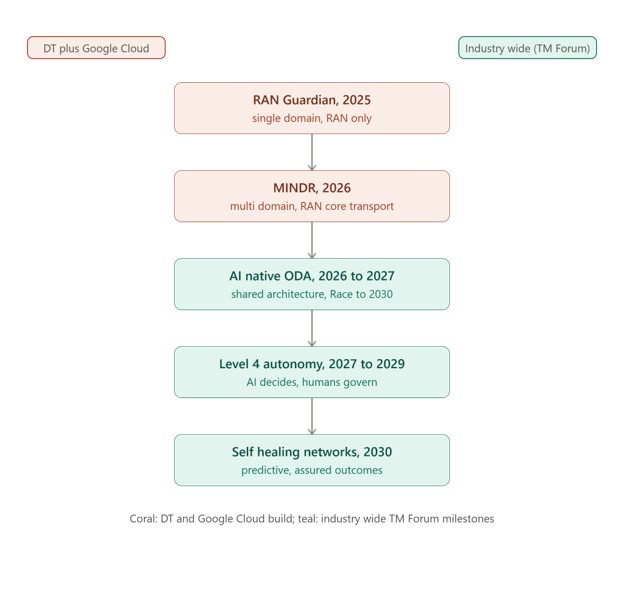
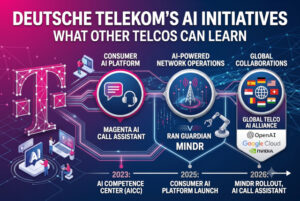
If you haven’t already, it’s worth reading our previous piece on RAN Guardian and MINDR first — it covers RAN Guardian’s launch and deployment in November 2025, the results it delivered for DT, and how MINDR, its successor, builds on those outcomes to offer considerably more in terms of scale and innovation.
RAN Guardian, DT and Google’s first multi-agentic AI system and built in line with TM Forum standards, now manages more than 100,000 events per year — about 100x more than before — with detection-and-fix speeds down to under a minute. Human approval is still required before an AI agent acts. MINDR is the sequel that generalizes this lesson. Instead of one domain and one use case, it spans RAN, core, and transport, with 15 or more identified use cases and a target of detecting issues in under a minute and generating root-cause analysis in under five. A co-pilot version rolled out in April 2026, with fuller autonomy targeted by the end of the year.
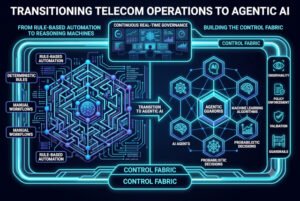
But that’s the DT-specific story. MINDR was unveiled at MWC 2026, and what turns this from “one operator’s good idea” into a forecast for the whole sector is what came next: a template built through DT and Google Cloud’s collaboration, designed so other telecom operators can apply the same agentic AI methodology to their own networks. Since Gen AI entered mainstream conversation in 2022, the industry has speculated about how AI would transform telecom operations. With RAN Guardian and MINDR, we now see that solution taking shape.
The industry sets its own deadline: Race to 2030
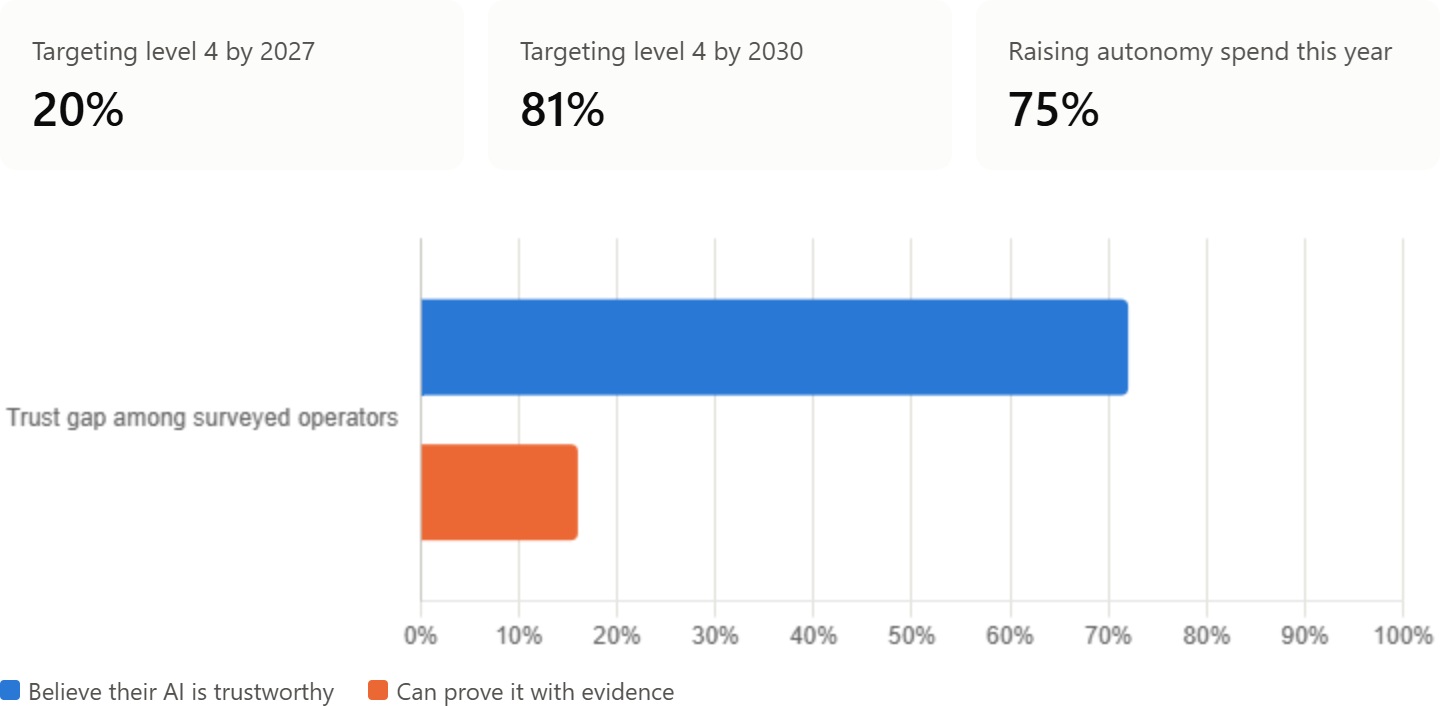
At DTW Ignite 2026, TM Forum — telecom’s own standards body — used its keynote to launch what its CEO, Nik Willetts, called the “Race to 2030.” It’s a direct challenge to every operator: stop running small AI experiments and start building AI into the core of how networks are run. The survey numbers behind that challenge, gathered from 80 telecom operators worldwide, are worth sitting with. One in five operators expect to reach a high level of network autonomy by 2027. Eight in ten are aiming for that same milestone by 2030. And three in four plan to spend more on this kind of technology this year alone.
To help operators get there, TM Forum also introduced a shared, common blueprint that any operator can build on — instead of everyone inventing their own approach from scratch, they can now build on the same foundation.
But the most striking moment of the keynote wasn’t about technology at all — it was about trust. Most operators say they believe their AI systems are trustworthy. But only a small fraction can actually prove it with the kind of evidence a regulator would accept. Willetts’ point was blunt: having the right technology isn’t enough. Without a way to prove these AI systems are safe and reliable, regulators and customers simply won’t let them take on more responsibility — no matter how good the technology gets.
Reading MINDR as a preview of the industry roadmap
Here’s the interesting part: MINDR isn’t just a story about one company’s product. It’s a working example of almost everything TM Forum is now asking the whole industry to do — built roughly a year before the industry framework that formalizes it.
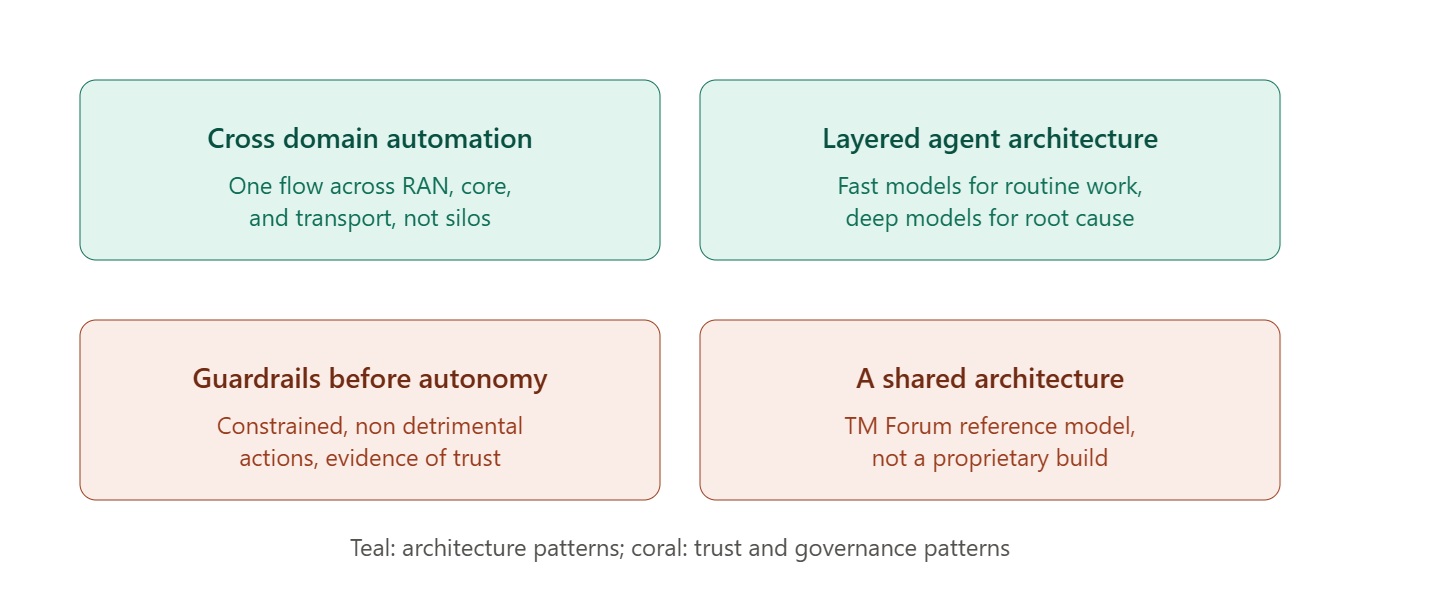
- Working across the whole network, not just one piece of it. TM Forum wants operators to move away from one-off AI tools and toward systems that work end-to-end. MINDR already does this across radio, transport, and the core network.
- Using the right tool for the job. MINDR uses fast, lightweight AI for routine checks and reserves its more powerful, slower AI for harder problems that need real reasoning — a pattern the industry is now recommending broadly to keep costs under control as AI use grows.
- Building in safety before independence. DT made sure its AI could never take a harmful action, even without a person watching in real time. That’s exactly the kind of proof of safety that TM Forum’s research says most operators still can’t produce.
- Building on a shared foundation, not a private one. DT and Google were explicit that MINDR is meant to be reused by other large operators, not kept to themselves — and it’s built around the same industry framework that TM Forum has now made its official reference model.
If MINDR shows what an early, well-resourced mover looks like, those Race to 2030 numbers tell us what everyone else is now planning to do about it.
My Five predictions for the next five years
- Most operators will adopt a shared blueprint rather than build their own from scratch. Since RAN Guardian launched, most major telecom operators have reportedly reached out to DT and Google Cloud — not for a specific tool, but to understand how they did it. Expect most large operators to build on TM Forum’s shared framework over the next two to three years rather than reinventing it themselves.
- “Supervised first” becomes the standard way to roll this out. MINDR’s own approach — start with a human-supervised version, then gradually hand over more control — is likely to become the industry’s default pattern, rather than operators trying to jump straight to full independence.
- Proving AI is trustworthy becomes its own business. With so few operators currently able to prove their AI is safe and reliable, expect real investment in tools that can produce that kind of evidence — this becomes just as important as the AI’s raw performance.
- The real competition shifts to data, not algorithms. Both DT and Google Cloud said the hardest part wasn’t building the AI — it was getting a clean, connected view of data from radio, transport, and core all in one place. Expect the next competitive edge among operators to come from who has the best-organized network data, not who has the flashiest model.
- By 2030, “the network just works” becomes a promise to customers, not just an internal goal. MINDR’s own tagline for the experience it’s building toward — “fast, reliable, invisible” — hints at where this is headed. Expect network reliability to shift from an invisible, back-office metric to something operators actively promise and market to customers.
The bottom line
DT and Google Cloud didn’t just build a product with MINDR — they built a rehearsal for what TM Forum has now made an industry-wide goal. The Race to 2030 isn’t just a slogan; it’s a deadline that most operators have already put on their own plans. The companies that move fastest over the next five years won’t necessarily be the ones with the most impressive AI — they’ll be the ones who, like DT, treat trust and structure as the starting point, and the AI itself as the easier part.
The technology to get there already exists. The only real question left before 2030 is who trusts their own AI enough to prove it.


Be First to Comment