In my previous LinkedIn post, I explored how telecom operators are beginning to unlock revenue opportunities from AI. This article attempts to answer an equally important question: why is this opportunity emerging now, and why should telecom leaders pay close attention to it?
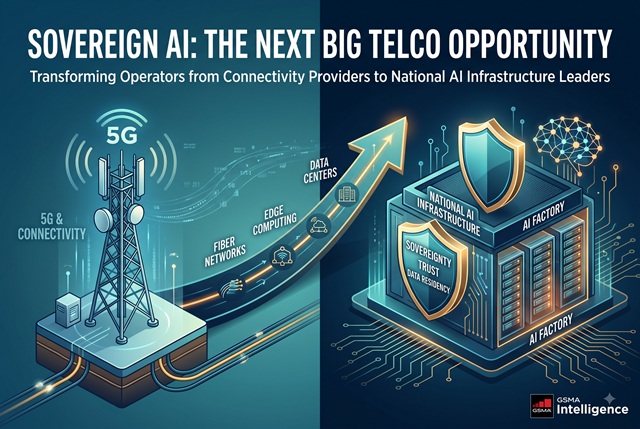
Last month, GSMA Intelligence released its Telco AI: State of the Market, Q2 2026 report, providing a comprehensive view of how AI adoption is evolving across the telecom industry. Since MWC 2026, we have witnessed Sovereign AI gaining significant momentum across the telecom ecosystem, and this report further validates that trend. While the report highlights numerous AI developments, one insight stands out above all others: Sovereign AI gives telecom operators a credible path to become national AI infrastructure providers, opening new revenue streams while leveraging assets they already own.
Deutsche Telekom’s AI Factory initiative is one of the strongest examples of this emerging direction. It demonstrates how operators are extending their role beyond connectivity and positioning themselves at the center of the AI value chain.
The fundamental premise is straightforward. While generative AI applications such as chatbots, assistants, and generic compute services carry significant potential, many of these offerings risk becoming commoditized over time. Sovereign AI, on the other hand, offers telecom operators a structural and long-term competitive advantage that even large hyperscalers may find difficult to replicate locally.
To understand why, it is important to recognize how AI conversations within telecom have traditionally evolved. Most discussions focus on chatbots, agentic AI, productivity gains, operational efficiencies, network automation, and AI-RAN. These are all important use cases that continue to deliver value. However, they are largely technology adoption stories centered on improving existing operations.
Sovereign AI represents something fundamentally different. It has the potential to reshape the telecom business model itself by positioning operators not merely as providers of connectivity, but as providers of trusted national AI infrastructure.
Historically, telecom operators built businesses around spectrum ownership, network infrastructure, and voice and data connectivity. In the emerging AI economy, however, enterprises and governments increasingly require trusted AI infrastructure, local data processing capabilities, sovereign compute capacity, regulatory compliance, cybersecurity controls, and assurance that sensitive information remains within national boundaries.
Fortunately, telecom operators already possess many of the assets needed to address these requirements. They own data centers, operate nationwide fiber networks, manage increasingly sophisticated edge infrastructure, maintain long-standing enterprise relationships, and enjoy a level of regulatory trust earned through decades of operating critical national infrastructure. Collectively, these advantages place telcos in a unique position that hyperscalers cannot easily recreate.
This strategic shift toward sovereign AI infrastructure is perhaps the most significant development the telecom industry has witnessed in recent years. It is being accelerated not only by rapid advances in AI technology but also by growing geopolitical considerations, regulatory requirements, and national ambitions around technology independence. Increasingly, governments do not view AI simply as a technology capability but as a strategic national asset.
Let us explore why this could become the industry’s next major growth engine.
Why I Believe This Is the Biggest Strategic Shift
According to the GSMA report, AI factories and sovereign AI infrastructure could contribute more than 5% in additional revenue growth for operators. At a time when telecom executives continue to navigate flat ARPU, slowing subscriber growth, and persistent pressure on connectivity revenues, this opportunity deserves serious attention.
For years, operators have struggled to differentiate in markets where connectivity has become increasingly commoditized. Sovereign AI introduces an alternative growth narrative. Instead of focusing solely on efficiency gains and cost reduction, operators can pursue high-value enterprise engagements, public sector partnerships, and strategic national infrastructure initiatives that generate long-term recurring revenue streams. In that sense, sovereign AI is not merely another operational improvement program; it represents a potential business model evolution.
The opportunity becomes even more compelling when viewed through a competitive lens. Over the past decade, hyperscalers such as AWS, Microsoft, and Google have captured a significant share of the value created by digital transformation. AI sovereignty has the potential to alter that dynamic. Governments and regulated industries are increasingly prioritizing data residency, in-country processing, sovereign control, and trusted infrastructure partners. This creates an environment in which telecom operators can become strategic enablers rather than being sidelined by global cloud providers. The GSMA report explicitly highlights regulated industries and compliance requirements as the primary drivers of sovereign AI deployments across markets.
Rather than attempting to compete directly with hyperscalers on large-scale AI model training or massive cloud infrastructure investments, telecom operators should concentrate on areas where they possess natural strengths. By combining targeted GPU infrastructure, private 5G capabilities, edge computing assets, localized cloud environments, and governance frameworks into integrated sovereign AI offerings, operators can create differentiated platforms that are difficult for competitors to replicate. GSMA Intelligence estimates suggest that such AI factory models could potentially generate service revenue uplifts ranging from approximately 1.5% to more than 5.7% depending on adoption levels.
Many operators are already experimenting with AI assistants, customer service bots, AI marketplaces, and other application-level services. While these initiatives undoubtedly create value, they are ultimately vulnerable to commoditization as AI capabilities become widely accessible. Sovereign AI infrastructure is fundamentally different because it is built upon physical and strategic assets that are far more difficult to replicate.
Operating sovereign AI capabilities requires data centers, network infrastructure, regulatory approvals, local market presence, cybersecurity expertise, and trusted governance frameworks. These are not new competencies for telecom operators. In fact, they represent areas where operators have spent decades building expertise and credibility.
This advantage becomes especially pronounced when considering the requirements of governments, healthcare organizations, defense agencies, and financial institutions. These sectors must comply with stringent regulations related to privacy, data residency, security, and national sovereignty. Because many hyperscalers are headquartered outside local jurisdictions, telecom operators possess a distinct trust advantage. Their national presence, established regulatory relationships, and physical infrastructure footprint position them as natural custodians of sovereign compute and trusted AI environments.
Conclusion
Sovereign AI is far more than the latest chapter in the AI story. It represents a rare opportunity for telecom operators to redefine their strategic role in the digital economy. For years, the industry has searched for meaningful growth beyond connectivity, often looking to adjacent services that failed to achieve scale or sustainable differentiation. Sovereign AI is different because it aligns directly with the assets operators already own, the trust they have built, and the regulatory environment in which they operate. The telecom leaders who succeed will not necessarily be those who invest the most in AI, but those who recognize that sovereignty, trust, compliance, and infrastructure are becoming as valuable as the AI applications themselves.
As nations increasingly seek control over their digital futures, telecom operators have an opportunity to evolve from connectivity providers into trusted national AI infrastructure partners. For many operators, this may prove to be the most significant strategic opportunity since the emergence of 5G.


Be First to Comment