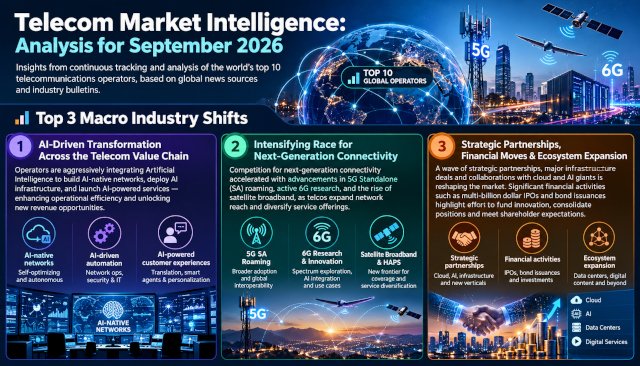
(I continuously monitor and analyze the world’s top 10 telecommunications operators through a range of news sources and industry bulletin subscriptions. Below is a summary of the key insights and trends identified from this analysis.)
The global telecom market in September 2026 was largely defined by an aggressive pivot towards Artificial Intelligence, with operators investing heavily in AI-native networks, infrastructure, and diverse AI-powered services to create new revenue streams. Competition for next-generation connectivity intensified across 5G Standalone roaming, advanced 6G research, and the burgeoning satellite broadband market. Concurrently, telcos pursued strategic partnerships, navigated significant financial activities like IPOs and bond issuances, and responded to evolving regulatory landscapes and shareholder activism.
Top 3 Macro Industry Shifts
- Telco operators globally accelerated their integration of Artificial Intelligence, focusing on developing AI-native networks, deploying AI infrastructure, and launching AI-powered services to enhance operational efficiency and unlock new revenue opportunities. This aggressive push spanned from AI-driven network automation and security to customer experience applications like AI translation and smart agents.
- The race for next-generation connectivity intensified significantly, characterized by advancements in 5G Standalone (SA) roaming capabilities and active global research into 6G technologies, including spectrum exploration and AI integration. Simultaneously, the satellite broadband market emerged as a critical new competitive frontier, with major telcos forming partnerships and developing High Altitude Platform Station (HAPS) solutions to expand network reach and diversify service offerings.
- A wave of strategic partnerships and ecosystem expansion dominated the financial landscape, encompassing major infrastructure deals, collaborations with cloud and AI giants, and efforts to diversify into new verticals like data centers and digital content. Significant financial maneuvers, including multi-billion dollar IPOs and bond issuances, underscored a broader strategy to fund innovation, consolidate market positions, and address shareholder expectations amidst a dynamic technological environment.
Operator-by-Operator Strategic Review
| Operator | Monthly Trend Summary |
| AT&T | AT&T aggressively expanded its enterprise and public sector connectivity with new Amazon Leo satellite partnerships and substantial fiber investments, while also making strides in AI security and navigating internal operational restructuring. |
| Verizon | Verizon prioritized massive investments in AI infrastructure, secured multi-billion dollar fiber deals, and actively pursued 6G research, signaling a strategic pivot towards future-proof networks and AI-driven services amidst ongoing operational adjustments. |
| T-Mobile US | T-Mobile US focused on AI-powered network automation and B2B expansion, achieving a world-first 5G SA roaming with Jio, even as it faced activist investor scrutiny and executive transitions. |
| China Mobile | China Mobile advanced its AI capabilities with neuromorphic AI and AI-native BSS, expanded into green data centers, and actively shaped 6G development and policy, while also adjusting customer acquisition strategies. |
| Vodafone | Vodafone prioritized network modernization with AI-powered RAN, expanded its digital services and data center footprint (Africa), while grappling with financial complexities for its Indian joint venture and advocating for policy changes. |
| Orange | Orange undertook major infrastructure investments, including new submarine cables and European data centers, while focusing on AI-driven network optimization and cybersecurity, alongside strategic bond issuances and emerging market commitments. |
| Telefonica | Telefonica concentrated on financial optimization through debt reduction and capital distribution, alongside strategic content deals and network upgrades, amidst market speculation regarding asset sales and analyst re-ratings. |
| NTT Docomo | NTT Docomo diversified investments into compact EVs and green technology, enhanced network capabilities with Open RAN and 5G millimeter-wave, and advanced generative AI for customer experience and internal operations. |
| SoftBank | SoftBank made substantial financial commitments to AI (OpenAI, over $10B in bonds), while also achieving key milestones in HAPS technology and 5G SA network deployment and facing valuation scrutiny. |
| Telstra | Telstra concentrated on bolstering network resilience and addressing service outages, while also achieving advanced transmission speeds and enhancing customer service platforms, facing calls for nationalization of emergency services. |
| Bharti Airtel | Bharti Airtel demonstrated strong subscriber growth, enhanced its premium offerings with Apple services, and actively fought digital fraud, amidst regulatory discussions on MNP and network slicing, and plans for a London IPO for Airtel Money. |
| Reliance Jio | Reliance Jio geared up for a major global IPO, achieved a world-first 5G SA roaming with T-Mobile, and continued to lead subscriber additions and expand its digital service offerings, engaging in regulatory debates on network slicing. |
| China Telecom | China Telecom aggressively pursued AI infrastructure development and launched AI-native models, while adapting to changes in customer acquisition strategies and contributing to 6G ambitions and smart city initiatives. |
| Deutsche Telekom | Deutsche Telekom navigated activist investor pressure and a leadership reshuffle, while driving its AI-native telco strategy, expanding IoT and enterprise security, and undergoing rebranding in key markets like Greece. |
| Singtel | Singtel underscored significant value from its Indian ventures, invested in critical subsea cable infrastructure, expanded digital entertainment, and focused on network resilience following a major Optus outage, while facing stock analysis. |
| SK Telecom | SK Telecom heavily invested in AI across services (AI for All, quantum networks, AI-RAN) and data centers, while also engaging in shareholder activism discussions, promoting ESG efforts, and developing AI-powered security solutions. |


Be First to Comment