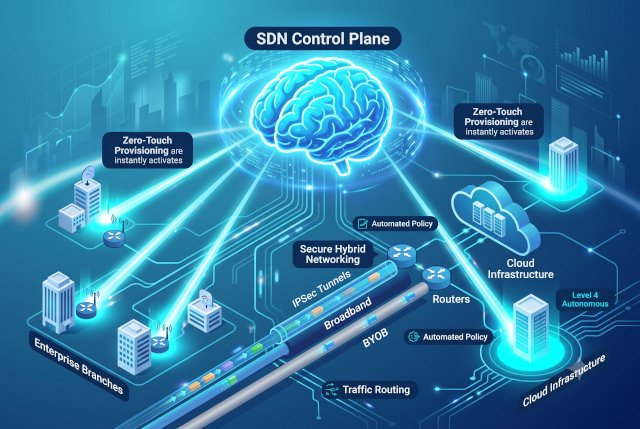
Enterprise branch connectivity has been stuck in the past for too long. For years, carriers relied on expensive dedicated MPLS circuits for SLA-critical traffic, paired with separate broadband links for everything else. The result? Weeks or months of provisioning, dual-connection complexity at every site, and constant truck rolls for manual configuration. Costs stayed high. Service velocity stayed low.
Forward-looking operators are shifting to Secure Hybrid Networking—encrypted IPSec tunnels over affordable broadband (including Bring-Your-Own-Broadband)—while keeping private-line grade security and performance. The real enabler is not just cheaper access. It is a purpose-built SDN control plane and orchestration layer that abstracts the network from the underlying hardware.
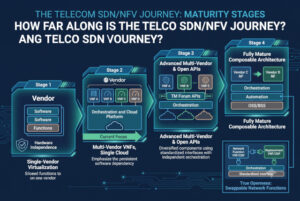
This is where vendor lock-in ends.
Proprietary ecosystems tie your automation scripts, policies, and OSS/BSS integrations to specific gear. Changing hardware or pushing consistent policy across thousands of endpoints becomes expensive and risky. Custom SDN controllers—such as ACL Digital’s CAMP (Configuration and Automation Management Platform), later evolved into O’Rover—change the equation. Through model-driven abstraction, open APIs, and standardized southbound interfaces, control logic is decoupled from physical switches, routers, and firewalls. Operators regain freedom.
The impact shows up clearly against TM Forum’s Autonomous Networks framework.
Industry data indicates that 75% of global operators plan to increase Autonomous Network investments, with more than 80% actively targeting Level 4 autonomy—networks that self-configure, self-heal, and self-optimize within domains with minimal human intervention.
A well-designed SDN control plane delivers the concrete capabilities that move operators from Level 3 toward Level 4:
- Zero-Touch Provisioning – Devices are pre-staged, self-register on boot, and pull intent-based configurations. Site turn-up collapses from months to minutes. Specialized technician dispatches disappear.
- Automated policy and traffic routing – Central orchestration continuously adjusts QoS and security based on real-time link health and application demand.
- Closed-loop operations – Telemetry feeds automated fault isolation and path optimization. Humans step in only when needed.
The outcome is measurable: lower field costs, faster service activation, eliminated vendor dependency, and a foundation that is ready for true Level 4 autonomy. This is not theoretical. It is the practical path carriers are taking today to transform enterprise connectivity from rigid hardware management into intent-driven, self-governing networks. The operators who treat the control plane as a strategic asset—not just another management tool—will set the pace.
My Question to all the leaders – What is the biggest barrier you still see between Level 3 and Level 4 in your network?
How do you agree with me?


Be First to Comment