Telecom Market Intelligence: Analysis for October 2026
October 2026 saw a significant acceleration in the telecom industry’s pivot towards #AI, with operators globally announcing major investments, savings targets, and strategic partnerships around artificial intelligence. Intense competition emerged from satellite-to-device (D2D) services, particularly SpaceX’s Starlink, leading traditional carriers to form joint ventures and express concerns about spectrum allocation. Meanwhile, emerging markets like India experienced landmark IPOs for digital platforms, while Europe focused on consolidating D2D efforts and upgrading network infrastructure.
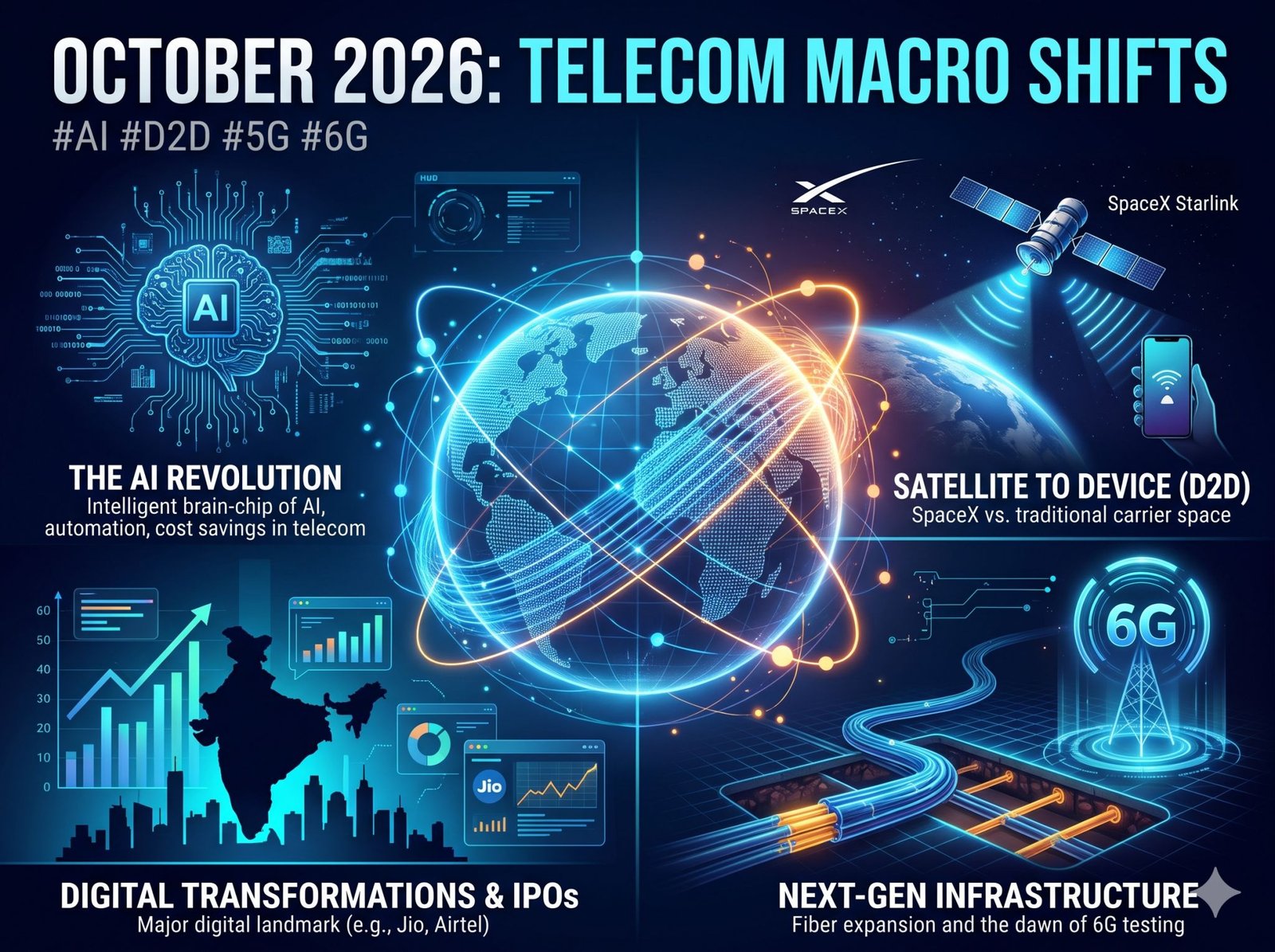
Top 4 Macro Industry Shifts
1. Telecom operators globally are aggressively adopting AI to drive network efficiency, automate operations, and unlock new revenue streams, ranging from AI-powered network optimization to innovative customer-facing services. This strategic shift is crucial for realizing significant cost savings and transforming telecom infrastructure into intelligent, adaptable platforms for future growth and competitive differentiation.
2. The emergence of satellite direct-to-device (D2D) connectivity, prominently led by SpaceX’s Starlink, is reshaping the competitive landscape for traditional mobile operators worldwide. This new threat has spurred a mix of defensive actions, including joint ventures among major carriers to standardize D2D, and collaborative efforts in Europe to secure spectrum and develop sovereign satellite services.
3. Telecom operators in rapidly developing economies, particularly India, are driving significant digital transformation through the listing of their digital service platforms. These massive IPOs, like Jio Platforms and Airtel Money, reflect strong investor confidence in the growth potential of #5G, #AI, and broader digital ecosystems in these markets, while also reshaping the competitive dynamics and valuations of local players.
4. The industry is seeing continued significant investment in fiber infrastructure expansion, particularly in developed markets, alongside the advanced testing and initial commercialization of #6G technologies. This dual focus highlights a commitment to both foundational network capacity and future-proof innovation, ensuring robust connectivity while preparing for the next generation of wireless communication.
