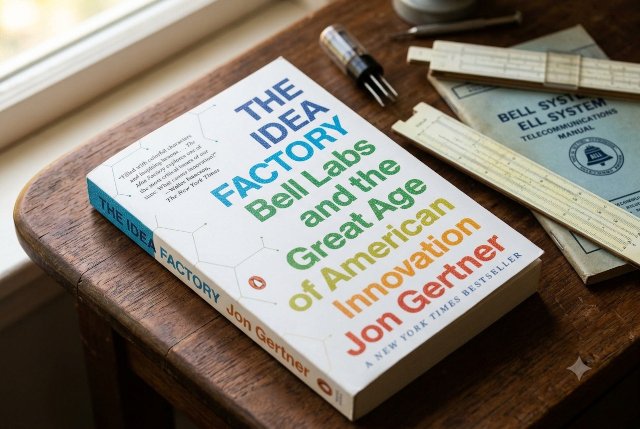
We have just entered another era of information innovation, driven by artificial intelligence. Yet, the foundations of this era were laid over the past 125 years through discoveries that transformed how we live, communicate, and understand the world. While exploring the deeper ideas and principles behind the digital age we are now experiencing, I came across The Idea Factory: Bell Labs and the Great Age of American Innovation by Jon Gertner. It took me some time to read, absorb, and truly appreciate this book. But after finishing it, I realized that it had ignited a new level of curiosity in me—one that I believe will stay with me for a long time. I have read about several successful information technology and communication companies and have shared reviews of some of them on this blog. However, Bell Labs taught me multiple lessons, all within a single paperback.
When it comes to research and development, I find it difficult to think of another organization that has contributed as much as Bell Labs. Originally established as the research and development arm of AT&T, it went far beyond its corporate mandate and delivered discoveries that transformed the world. We often overlook the importance of the technologies surrounding us, without realizing the remarkable research and experimentation that made them possible. As the title suggests, Bell Labs became an idea factory, generating countless innovations and laying the foundations for much of the technological progress we experience today.
From transistors and fiber optics to lasers and cellular telephony, it is difficult to find an aspect of modern life that has not been touched by Bell Labs.
Jon Gertner, a journalist and historian, does an excellent job of bringing this remarkable story to life. His writing strikes the right balance between technical depth, historical context, and human stories. I have read many nonfiction books, but there was something distinctive about his narrative that kept me engaged for hours. The book challenged me to think beyond individual inventions and consider the environment, people, and collective efforts that make extraordinary innovation possible. It was precisely the kind of intellectual stimulation I was looking for.
Gertner chronicles the rise and golden era of AT&T’s Bell Telephone Laboratories—an extraordinary research institution where physics, chemistry, and engineering came together to create the physical and mathematical foundations of our modern digital world. The book takes us through a period when scientific curiosity was supported by an environment that gave researchers the time, resources, freedom, and opportunity to explore ideas that might not have produced immediate results. It offers a fascinating glimpse into how such an environment helped turn ambitious scientific questions into discoveries with far-reaching consequences.
The Idea Factory is a masterclass in how institutional culture, visionary leadership, and interdisciplinary collaboration can alter the course of human history. Gertner balances complex scientific concepts with compelling human stories, making the book an engaging read for anyone interested in technology, history, innovation, or organizational design. For me, its greatest lesson is that groundbreaking innovation rarely happens in isolation. It flourishes when curious minds are given the freedom to experiment, the resources to pursue difficult questions, and the opportunity to learn from one another. As we enter an era increasingly shaped by AI, revisiting the story of Bell Labs offers a valuable perspective on the kind of environment we need to build to enable the next generation of transformative ideas.






Be First to Comment