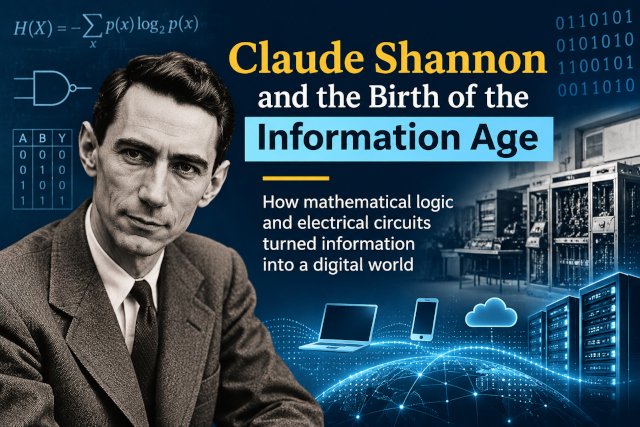
I have recently started reading A Mind at Play: How Claude Shannon Invented the Information Age by Jimmy Soni and Rob Goodman. Whenever I pick up a book, I find myself searching for its central idea—the fundamental story the author wants to tell. More importantly, I look for the origins of an idea or invention that eventually changes the world.
With this book, my curiosity was about understanding where the information revolution really began.
The story takes us back to the early days of computing, introducing us to an enormous analogue computing machine called the Differential Analyzer. Occupying an entire room, this machine was developed to solve complex mathematical equations. Claude Shannon was assigned to operate it under the guidance of his mentor, Vannevar Bush, at MIT.
What makes this part of the story particularly interesting is how it introduces the relationship between mathematical logic and computing—a relationship that would eventually transform the world.
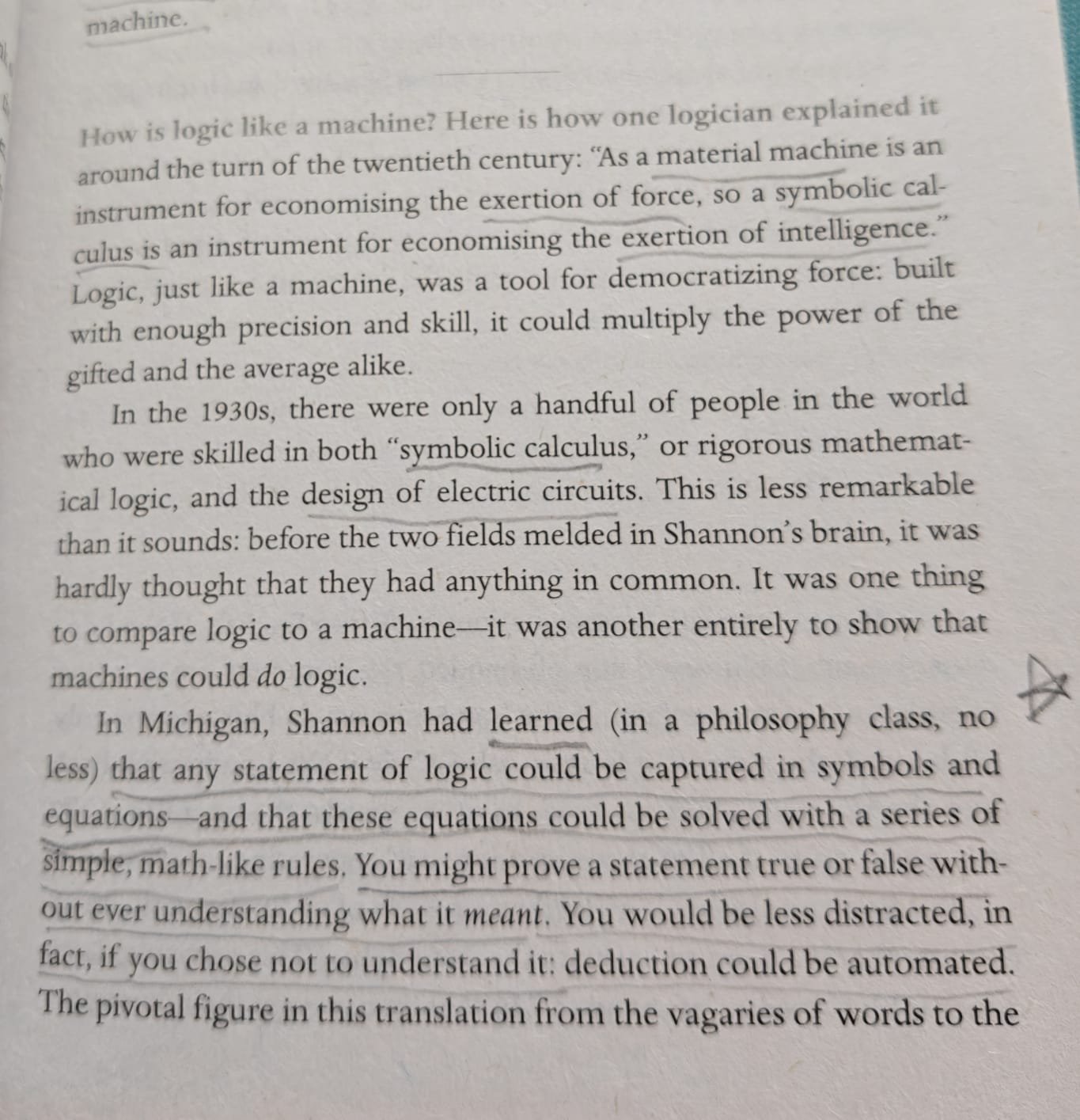
One idea that caught my attention was the explanation of how logic could reduce human intellectual effort. Just as physical machines help us overcome our physical limitations, mathematical logic can help us overcome the limitations of human reasoning. A machine can multiply our physical strength, while a system of logic can effectively multiply our intellectual capabilities, making complex problem-solving more accessible.
As the book notes, during the 1930s, mathematical logic and electrical circuit design were considered two entirely different disciplines. Very few people understood both fields well enough to recognise a connection between them.
Claude Shannon was one of the few people who did.
While studying at the University of Michigan and later working at MIT, Shannon recognised something remarkable. He understood that logical statements could be represented using mathematical symbols and equations. These equations could then be evaluated by following a set of simple rules.
In other words, it was possible to determine whether a logical statement was true or false by applying mathematical operations, without necessarily needing to understand the actual meaning of the statement.
This raised an extraordinary possibility: What if logical reasoning itself could be automated?
Shannon’s breakthrough was recognising that the principles of Boolean algebra and mathematical logic could be translated into electrical circuits. Electrical switches could represent logical values, and their combinations could perform logical operations.
This seemingly simple connection between mathematics and electrical engineering became one of the most important foundations of modern digital computing.
Looking back, it is fascinating to realise that the computers we use today, from smartphones and laptops to massive data centres powering artificial intelligence, are built upon principles that Shannon helped establish nearly a century ago.
Sometimes, technological revolutions do not begin with the invention of a massive machine or a breakthrough in hardware. They begin with someone recognising a connection between two seemingly unrelated fields.
That is what makes Claude Shannon’s story so fascinating. He did not simply contribute to the development of computing; he helped establish the mathematical foundations of the information age we live in today.
I am looking forward to discovering more about Shannon’s ideas and the journey that eventually led to the digital world we now take for granted.




Be First to Comment