Modern networks don’t automatically mean new revenue. Here’s what 9 years in this space has taught me. For the last 9 years, I’ve been writing about and advocating cloud-native transformation for telco network infrastructure. Software-defined network functions and microservices are, in my opinion, revolutionary. Over the past decade, many operators have adopted these architectures and methods.
That matters for what comes next. Operators that invest in open, cloud-native networks are better positioned to adopt AI at speed and scale. Openness, programmability and automation form the operating model foundation for AI-native networks, AIOps and, increasingly, agent-based operations.
But here’s the catch: investment does not translate into revenue on its own.
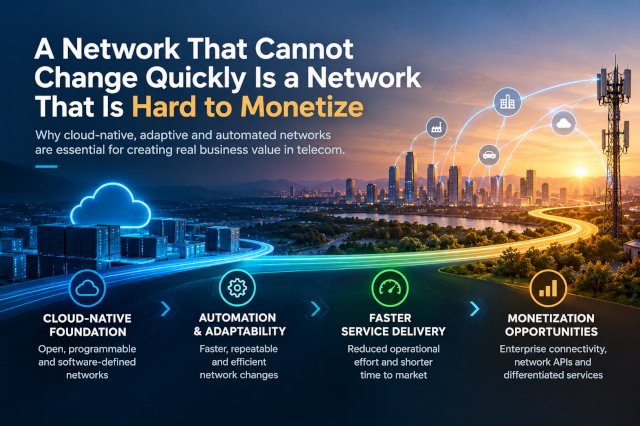
The goal should never be just a “modern” network. It should be an adaptive one: a network that changes as subscribers and enterprise customers need it to. It has to be programmable, adaptable and economical enough to run that the operator can turn its capabilities into services customers value and are willing to pay for. This was a key theme at TelecomTV’s Cloud Native Summit, in a panel discussion with speakers from Swisscom and Telstra.
Consider an enterprise customer asking for a specialized connectivity service. If delivering it means:
→ Weeks of manual configuration work
→ Coordination across multiple vendors
→ Repeated rounds of testing
…the operator may struggle to launch quickly, let alone profitably.
Now flip it. When deployment, configuration, testing and service lifecycle management are automated:
→ Network changes become repeatable
→ Operational effort drops
→ Service delivery times shrink
That builds a stronger foundation for commercializing enterprise connectivity, network APIs and other differentiated services. The network stops being a cost to maintain and becomes a platform to monetize, one service at a time.
At ACL Digital, we help operators reduce the time, effort and risk involved in changing their network, so they can deliver new services more efficiently.
To be clear, automation doesn’t promise new revenue by itself. What engineering can do is remove the obstacles that make service innovation and commercialization difficult. The commercial strategy, from pricing to partnerships to go-to-market, still has to follow.
The operators who win won’t be the ones with the most modern networks. They’ll be the ones whose networks can adapt the fastest to what customers actually want. Agility, not modernity, is the real competitive edge.
How is your organization turning network transformation into something customers will pay for? I’d love to hear your thoughts and experiences in the comments.






Be First to Comment