When people talk about AI adoption at telecom operators, they usually mean layering AI onto processes that already exist — a call center script, a network fault-ticket workflow, an approval chain. A chatbot answers FAQs before a human agent takes over. A copilot drafts an email inside an otherwise unchanged approval process. The workflow’s shape, its number of steps, its handoffs, all stay exactly as they were; AI just makes one step faster.
But speeding up a step isn’t the same as fixing the process. If a workflow has 14 steps, AI can accelerate all 14 — it won’t ask why they exist in the first place.
“Becoming AI-native is not about adding AI to the way we work today. It is about redesigning the work itself.”
— Jonathan Abrahamson, Chief Product & Digital Officer, Deutsche Telekom (as told to OpenAI)
Being “AI-native” means asking a harder question than “how do we speed up step 7?” It means asking whether the process needs 14 steps at all, once an AI system can reason across the whole thing at once.
Why telecoms feel this acutely
Telcos are unusually process-heavy. Network provisioning, fault management, billing, regulatory compliance, field service dispatch — all built up over decades as sequential, handoff-heavy workflows designed for human-only execution. Many of those steps exist purely to pass information between people or systems that couldn’t otherwise “see” each other. That’s exactly the kind of legacy structure the AI-native shift targets.
AI’s real value shows up when it can collapse those handoffs, because a system can now hold context across the whole journey — not when it simply makes each existing handoff a little faster.
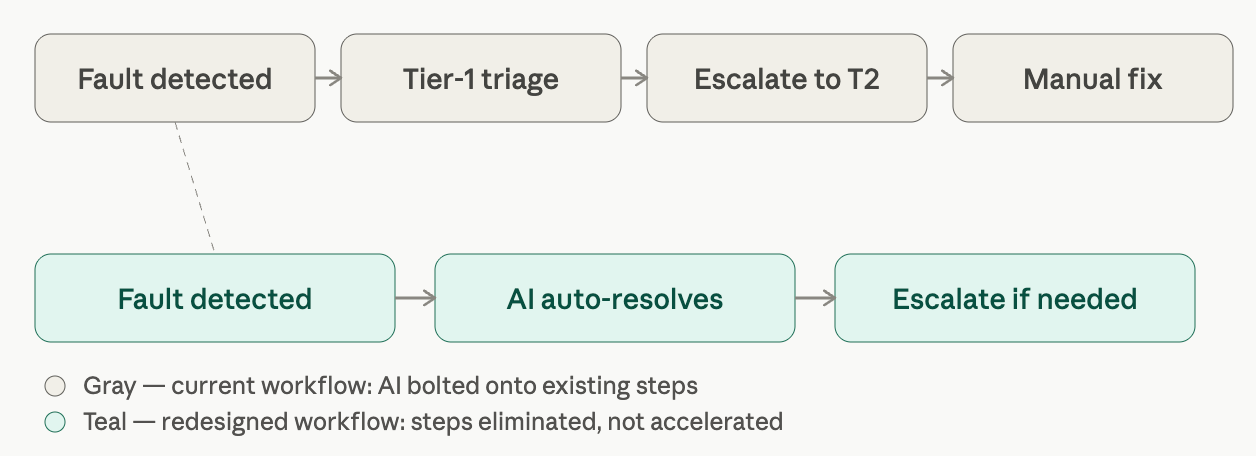
The top row is the familiar version: a four-step process with AI inserted at one node — a chatbot helping with tier-1 triage, say. The escalation ladder, the handoffs, and the wait times are all still there, just slightly faster.
The bottom row is the redesigned version: a three-step process where the handoffs themselves are removed. AI holds enough context to diagnose and resolve most faults on its own, and a human enters the picture only for genuine edge cases — escalation becomes the exception, not a scheduled step. That’s the real difference between adding AI to the way we work and redesigning the work itself: the first optimizes a step, the second asks whether the step needs to exist at all.





Be First to Comment