This article is prepared with the help of the GSMA The Mobile Economy 2026 report published this year.
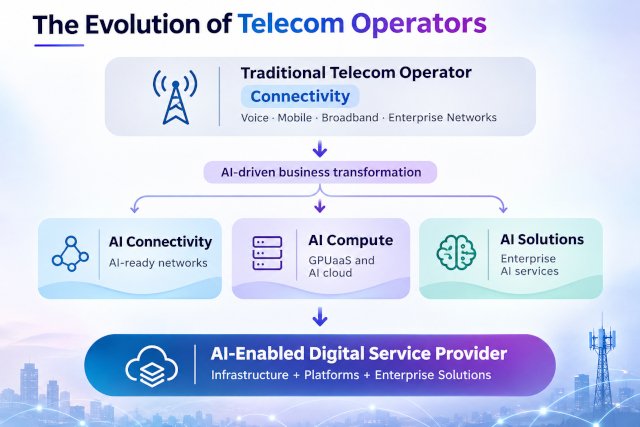
For decades, telecom operators have built their businesses around one fundamental service: connectivity. From mobile voice and broadband to enterprise networking and 5G, their primary role has been to connect people, businesses and devices.
However, the emergence of artificial intelligence (AI) is creating an opportunity for telecom operators to rethink this traditional business model.
According to GSMA’s The Mobile Economy 2026 report, operators are increasingly exploring new service domains beyond connectivity, including GPU as a Service (GPUaaS), AI platforms, IoT and cloud gaming. These opportunities represent a structural shift in how telecom companies can participate in the digital economy and generate new sources of revenue.
The opportunity is significant, but so is the competition. Hyperscalers, enterprise IT companies and established AI platform providers already have strong positions in cloud computing, AI infrastructure and enterprise applications. Telecom operators, however, bring a different set of advantages: extensive network infrastructure, geographically distributed assets, data centres, enterprise relationships and the ability to deliver services closer to end users.
This puts operators in a position to participate in the AI value chain, although success will require investments in computing infrastructure, software ecosystems and specialised talent.
Interestingly, the emerging landscape is also pushing telecom operators towards partnership-led business models. Rather than competing directly with global cloud and AI providers, operators are collaborating with hyperscalers, AI platform companies and technology vendors. These partnerships help accelerate time to market, reduce investment risks and create differentiated offerings around integration, localisation, data sovereignty and network-embedded capabilities.
Three emerging revenue models illustrate how telecom operators are approaching this opportunity.
1. AI Connectivity Provider: Making Networks AI-Ready
As AI workloads become increasingly distributed across cloud environments, data centres, enterprise locations and edge infrastructure, connectivity requirements are changing.
AI applications often require high bandwidth, low latency, reliability and secure data exchange. Telecom operators can leverage their existing network infrastructure, edge computing capabilities and data centres to deliver connectivity services optimised for AI workloads.
This creates opportunities to move beyond conventional connectivity pricing towards value-based services. Examples include AI-specific network slicing, Connectivity as a Service (CaaS), private 5G networks and edge-based AI processing.
Instead of simply selling bandwidth, operators can offer connectivity environments designed around the performance, security and operational requirements of enterprise AI applications.
Industry examples:
- Singtel: Its Paragon platform brings together private 5G, edge computing and service orchestration. Through integration with NVIDIA’s accelerated computing and AI enterprise stack, the platform supports AI-intensive and graphics-intensive workloads.
- Reliance Jio: Its enterprise connectivity portfolio, which includes MPLS VPNs, SD-WAN and leased lines, provides an important infrastructure foundation for enterprise AI initiatives, including the joint enterprise AI offering from Reliance Industries and Meta.
The opportunity here is to position network infrastructure as an integral component of enterprise AI delivery rather than treating connectivity as a standalone commodity.
2. AI Compute Provider: Turning Infrastructure into AI Revenue
The rapid adoption of generative AI and large language models is driving demand for high-performance computing infrastructure, particularly GPUs.
Training and running AI models require substantial computing capacity, specialised infrastructure and reliable access to processing resources. This is creating an opportunity for telecom operators to repurpose their cloud infrastructure, data centres and other assets to offer GPU-powered computing services.
Operators are exploring business models such as GPU as a Service (GPUaaS), on-demand compute reservations, subscription-based access to AI infrastructure and sovereign AI cloud services.
The sovereign AI opportunity is particularly interesting. Governments and enterprises increasingly want greater control over where their data is stored, how AI models are deployed and which infrastructure processes their workloads. Telecom operators with local infrastructure and established enterprise relationships can potentially address these requirements.
Industry examples:
- Deutsche Telekom: In November 2025, the company launched its Industrial AI Cloud, backed by a €1 billion AI factory investment. The infrastructure provides GPU-powered computing resources for industrial applications, large language model development, digital twins and robotics.
- SK Telecom: In August 2025, the company launched Haein, its sovereign GPUaaS platform. Featuring more than 1,000 NVIDIA B200 GPUs, the platform provides enterprise and government customers with on-demand access to high-performance computing capacity.
These initiatives demonstrate how telecom operators can transform their data centres and infrastructure investments into new AI-focused service businesses.
The business opportunity extends beyond providing access to GPUs. Operators can potentially generate revenue through infrastructure management, compute provisioning, cloud services and specialised AI infrastructure offerings.
3. AI Solutions Partner: Moving Up the Enterprise AI Value Chain
Providing connectivity and computing infrastructure is only one part of the AI opportunity. Enterprises also need help identifying relevant use cases, integrating AI into existing systems, deploying models and managing AI applications.
This creates another opportunity for telecom operators: becoming AI solutions partners.
Instead of building every capability independently, operators can collaborate with hyperscalers, AI platform providers and enterprise software companies to develop and deliver industry-specific AI solutions.
These offerings can span consulting, AI implementation, systems integration, managed AI services and enterprise AI platforms.
The associated revenue models are also different from traditional connectivity services. Operators can generate revenue through consulting and integration fees, managed service contracts, joint go-to-market offerings, revenue-sharing arrangements and ecosystem-based marketplaces.
Industry examples:
- KDDI: The Japanese operator provides infrastructure design, development, operations and maintenance services in collaboration with technology partners, including Iiret, an AWS Premier Tier Services Partner. These services help local businesses adopt generative AI solutions.
- China Telecom: Its Xingchen Large Language Model has been deployed across more than 50 industries, including government affairs, healthcare and education, demonstrating how operators can extend their AI capabilities into industry-specific applications.
- Reliance Jio: Through JioBrain, the company offers an AI platform designed to help businesses deploy generative AI tools and advanced analytics. The platform supports enterprise requirements such as training and deploying customised large language models, with access to models including GPT, Claude and Llama.
This model offers telecom operators an opportunity to develop deeper relationships with enterprise customers and participate in the value generated through AI adoption, rather than limiting their role to infrastructure providers.
What Does This Mean for the Telecom Industry?
The emergence of these three revenue models signals a broader transformation in the telecom business landscape.
Operators are no longer looking at AI merely as a technology to improve network operations, customer experience or internal efficiency. Increasingly, they are exploring how AI infrastructure, platforms and solutions can become independent commercial offerings.
However, the transition will not be straightforward. Building AI infrastructure requires substantial capital expenditure, access to specialised computing resources, software capabilities and skilled professionals. Competing with established hyperscalers across the entire AI value chain may also be difficult.
This is where partnerships become strategically important. By combining their network assets, local presence and enterprise relationships with the technology capabilities of hyperscalers and AI providers, telecom operators can create differentiated offerings without having to build every component themselves.
The bigger shift is in how telecom operators define their role in the digital economy.
The next phase of telecom growth may not be driven exclusively by connecting more people and devices. It could increasingly come from enabling AI workloads, providing access to computing infrastructure and helping enterprises translate AI investments into business outcomes.
Connectivity will remain the foundation, but the opportunity is expanding well beyond it.


Be First to Comment