Deutsche Telekom (DT) stands out as one of the most forward-looking telecom operators when it comes to translating AI innovation into real, deployed initiatives. I’ve been following their progress closely, and the insights are worth sharing with anyone tracking how AI is reshaping the telecom industry.
Their AI philosophy, as described by Chief Product & Digital Officer Jonathan Abrahamsen, captures the ambition well: DT isn’t looking to upgrade isolated parts of the network with AI. Instead, the company wants to become AI-native by redesigning its operating architecture from the ground up. That mindset underpins every initiative that follows.
To execute this strategy, DT is actively collaborating with leading AI players including OpenAI, Perplexity, NVIDIA, and Google Cloud, among others.
Here’s a closer look at their key AI initiatives.
Partnership with OpenAI, Perplexity, and Other Players
DT has signed a multi-year strategic partnership with OpenAI. All 200,000 DT employees now have access to ChatGPT Enterprise, running on dedicated EU-based computing clusters that keep data within European boundaries and ensure GDPR compliance. The deployment already counts more than 50,000 monthly active users across internal generative AI systems and APIs, with internal AI utilization up 546% since the start of the year. Employees rely on AI copilots to parse analytics, draft communications, dig through customer and network systems, and automate routine documentation. Notably, DT’s rollout was deliberately hands-off at the start: put the tools in employees’ hands, let them experiment, and use adoption data to identify which workflows are worth scaling further.
Also with OpenAI, DT is co-developing a specialized large language model trained on the company’s global network logs, fault tickets, and customer service recordings. Its capabilities include automated fault detection, predictive maintenance, and customer resolution optimization. The beta launched in H2 2025 across Germany and Austria, with commercial rollout now underway from Q1 2026 and expansion planned for France and Italy.
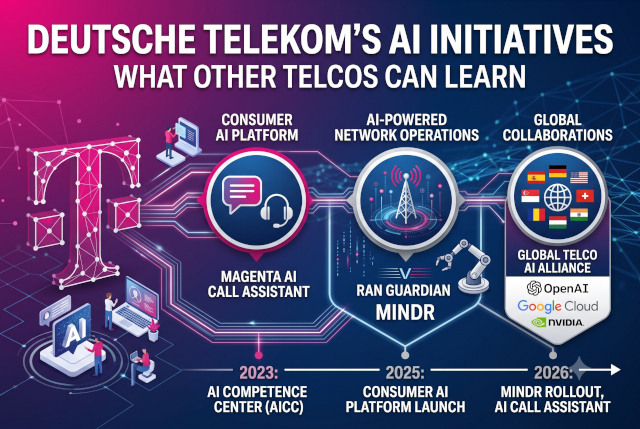
Under the Magenta AI brand, DT runs two active initiatives: the Magenta AI Consumer Platform and the Magenta AI Call Assistant.
With the Consumer Platform, DT’s goal is to make AI accessible to everyone — not just tech enthusiasts. It’s an AI ecosystem built into the MeinMagenta app, serving millions of DT customers across Germany. DT has partnered with Perplexity (AI search and assistant), Google Cloud AI, ElevenLabs (voice AI synthesis), and Picsart (image AI) to power it. Launched in summer 2025, the platform now serves as the central hub for all of DT’s consumer-facing AI services.
The more significant initiative is the Magenta AI Call Assistant — the world’s first network-embedded AI call assistant. Deutsche Telekom unveiled it at Mobile World Congress 2026 in partnership with ElevenLabs. Rather than running as an app on a phone, the assistant lives inside the network itself and processes calls in real time. During a call, it can translate live between languages, take notes, guide the caller through complex tasks, and generate a structured summary once the call ends.
“We are the first in the world to offer these network-based AI functions. We remove barriers — no apps, no special devices, no technical complexity. AI becomes simple, intuitive and available to everyone.”
— Abdu Mudesir
Concepts DT Is Working On
DT is also working on an AI Phone concept, expected to arrive within the next 3-5 years. Unveiled at MWC 2025, it envisions an app-less phone where AI agents replace individual applications entirely. The concept is powered by Perplexity AI (search), Google Cloud (AI services), and Qualcomm (on-device AI chipsets), and explores a future where conversational AI agents handle all the tasks that currently require separate apps.
Another concept in development is AI-Powered Smart Glasses — a voice-controlled AI wearable unveiled at MWC 2026. It extends Magenta AI beyond the smartphone, making AI services accessible via voice through a wearable device. For now, it remains a concept study with no confirmed commercial timeline, but it signals DT’s broader vision for AI-first hardware interfaces.
Network and Infrastructure
This year, DT launched Germany’s first Industrial AI Cloud in Munich, in partnership with NVIDIA and Polarise — one of Europe’s largest sovereign AI infrastructure initiatives, designed to strengthen Germany’s and Europe’s digital sovereignty. Built in just six months, the AI factory delivers secure, high-performance AI computing for enterprises, research institutions, startups, and the public sector, supporting use cases in AI, digital twins, robotics, and simulation. It’s powered by nearly 10,000 NVIDIA Blackwell GPUs, delivering up to 0.5 ExaFLOPS of AI performance. The platform also forms the foundation of the “Deutschland Stack,” which combines T-Systems’ cloud infrastructure with SAP’s Business Technology Platform to deliver an end-to-end sovereign AI ecosystem for industrial and government applications.
On the automated network operations front, DT launched RAN Guardian Agents with Google Cloud last year, using an agentic AI approach. Deployed in November 2025, the initiative has already shown measurable outcomes. This year, DT took it a step further with its successor, MINDR (Multi-agentic INtelligent Network Diagnostics and Remediation). Rather than focusing on a single domain and use case, MINDR spans RAN, core, and transport, covering 15 or more identified use cases, with a target of detecting issues in under a minute and generating root-cause analysis in under five. A co-pilot version rolled out in April 2026, with fuller autonomy targeted by the end of the year. With MINDR, DT is targeting TM Forum Level 4 autonomy, with Level 5 autonomy planned by 2030. This platform represents a significant milestone — one that other telecom operators pursuing Level 4 autonomy will likely watch closely.
Collaboration with Other Telecom Partners
At MWC 2026, DT joined Ericsson, Nokia, SK Telecom, SoftBank, T-Mobile, and Cisco in committing to build 6G on open, secure, AI-native, software-defined platforms — an initiative led by NVIDIA. As Jensen Huang put it: “AI is redefining computing — telecommunications is next.” DT is a founding member of this coalition.
Global Telco AI Alliance (GTAA): Founded by DT alongside e& (UAE), Singtel (Singapore), and SK Telecom (Korea), the alliance aims to develop new AI models and growth drivers for telcos, spanning Europe, the Middle East, Southeast Asia, and Northeast Asia. It’s arguably the most strategically important operator alliance in AI globally.
Internal Competence for AI
The AI Competence Center (AICC) is an internal unit established by Deutsche Telekom in 2023 to pool and scale the Group’s AI expertise. Led by industry experts, the AICC advises the business, drives AI transformation, and builds cutting-edge tools for customer sales and service. It serves as DT’s internal center of excellence, coordinating AI strategy, tool adoption across national companies, model development, and ethical AI governance — ensuring a consistent AI approach across Telekom Deutschland, T-Systems, and all European subsidiaries.
Key Takeaways for Other Telcos to Follow
DT is a leading telecom operator that has taken major steps in defining and implementing AI strategy across multiple domains. A few key takeaways stand out for other operators charting their own AI path.
AI infrastructure is a major focus area. With nearly every leading operator outside the US investing in enterprise AI, building an AI factory has become a critical initiative for telecom players. Today, that list includes DT, SK Telecom, Singtel, China Telecom, NTT Data, KDDI, Telefónica, Reliance Jio, Telenor Norway, and Orange Europe. As these operators build out their AI factories, they remain strategically aligned around sovereign AI, adhering to government requirements to keep data within regional boundaries. This is set to become a significant business area in the coming years, and DT, SK Telecom, and a handful of other operators have already made major investments and taken clear architectural positions.
Telecom operators are also leaning on their R&D capabilities, whether through in-house teams or system integration vendors, to stay ahead in the global telecom race. The AI Call Assistant, AI Phone, and Magenta AI Platform are good examples of this in action — initiatives researched and developed in collaboration with vendors and ecosystem partners.
Strategic collaborations with LLM providers and chip vendors like NVIDIA and Qualcomm are another recurring theme across the industry.
Finally, telecom operators are increasingly open to sharing knowledge and collaborating with peers to bring AI to their networks — particularly in the RAN domain, where the greatest opportunity lies in optimizing cost and energy use.

Be First to Comment