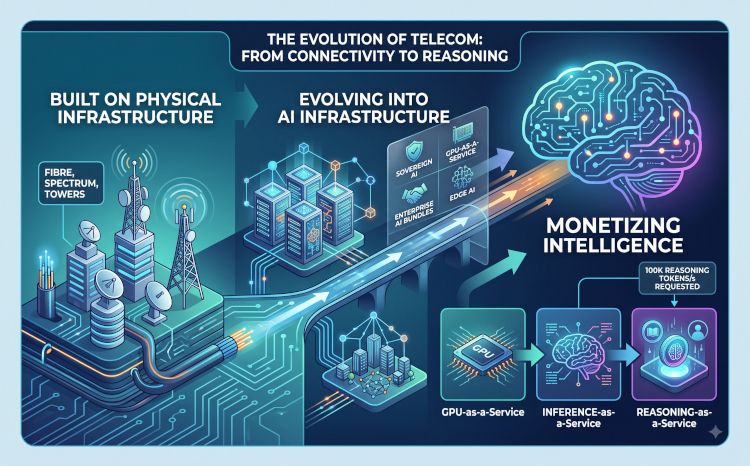
Telecommunications operators built their businesses on a simple premise: own scarce physical infrastructure—spectrum, fibre, towers, exchanges—and rent access to it.
That premise is now being rewritten.
Across 2025 and 2026, the same infrastructure that once carried voice and data is rapidly evolving into the foundation of a new business: AI Infrastructure.
The most exciting part? This is no longer a future vision. Operators are already generating measurable revenue from AI infrastructure through AI-ready data centers, GPU clouds, sovereign AI platforms, and enterprise AI services.
Some notable examples include:
- SoftBank is expanding its AI and cloud strategy while investing in next-generation digital infrastructure.
- Ooredoo Group expects digital infrastructure revenue to grow from 3% of total revenue in 2025 to 12% by 2030.
- Indosat Ooredoo Hutchison expects AI Neocloud revenue to reach $60M in 2026, backed by approximately $170M in contracted revenue over the next three years.
- SK Telecom already generates meaningful data center revenue and targets KRW 1 trillion by 2030.
- TELUS reported 22% YoY AI-enabled revenue growth.
- KT Corporation delivered 27.4% YoY growth in its cloud business, driven by sovereign AI and enterprise AI workloads.
What is driving this new revenue opportunity?
- Sovereign AI and data residency for governments and regulated industries
- GPU-as-a-Service and AI-ready colocation
- Enterprise AI bundles combining connectivity, cybersecurity, cloud, and managed services
- Internal AI adoption that funds external AI infrastructure investments
- Edge AI and hyper-local compute for ultra-low-latency enterprise applications
But I believe the next evolution is even more interesting.
Over the next five years, we may see compute become a real-time utility rather than a fixed resource inside a data center.
Instead of purchasing virtual machines, enterprises may simply request:
“I need 100,000 reasoning tokens per second for the next 30 minutes.”
The platform would automatically orchestrate GPUs, CPUs, memory, networking, storage, inference accelerators, and edge infrastructure to deliver that capacity on demand.
Customers won’t be paying for servers. They’ll be paying for reasoning capacity.
This could redefine telecom’s AI business model: From Compute-as-a-Service to Inference-as-a-Service to Reasoning-as-a-Service.
That represents a much larger opportunity than today’s GPU-as-a-Service.
Telecom operators spent decades monetizing connectivity. The next decade may be defined by monetizing intelligence.


Be First to Comment