Technology exhibitions are often filled with impressive demonstrations, futuristic innovations, and conversations about what comes next. But sometimes, the most memorable experience is not about the most advanced technology. It is about discovering how technology can address real-world challenges and make a difference in people’s lives.
That was precisely our experience at India Mobile Congress 2026.
An Unexpected Encounter at the Vodafone Idea Booth
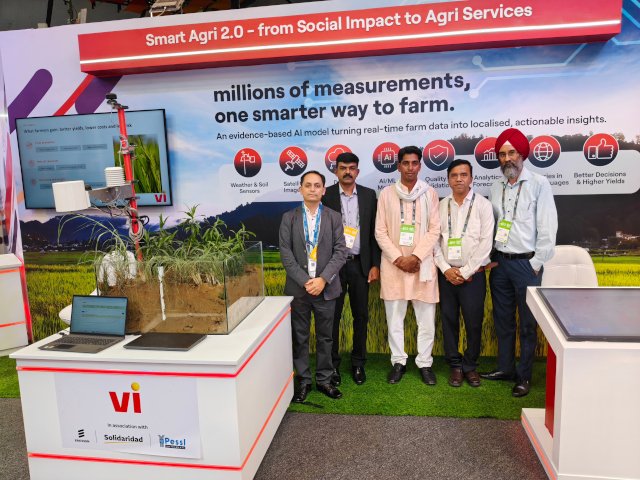
While walking through the exhibition halls and exploring the latest innovations, we stopped at the massive Vodafone Idea booth. Something unusual caught our attention: a person dressed like a farmer, standing out amid the technology displays and corporate showcases.
Curiosity led us to start a conversation. What followed was an engaging discussion about the challenges faced by Indian farmers and how technology-driven initiatives could help address some of the most pressing issues in agriculture.
We spent a considerable amount of time learning about the Smart Agri 2.0 initiative, and the conversation left us thinking about the broader role that telecommunications and digital technologies can play beyond traditional connectivity.
Smart Agri 2.0: Technology with a Purpose
Agriculture remains central to India’s economy and the livelihoods of millions of people. Yet farmers continue to face significant challenges, including unpredictable weather, water scarcity, rising input costs, crop losses, and financial uncertainty.
These challenges are interconnected, and addressing them requires more than isolated technological interventions. It calls for solutions that can help farmers make informed decisions, use resources more efficiently, and improve the resilience of their agricultural practices.
This is where initiatives such as Smart Agri 2.0 become particularly interesting. They bring attention to the potential of technology to support agriculture and demonstrate how digital innovation can be relevant to communities far beyond urban centres and traditional enterprise environments.
The broader opportunity for telecom-enabled agriculture lies in connecting information, services, and decision-making with the people who need them most. Depending on the solutions deployed, connectivity and digital platforms can support smarter agricultural practices, more efficient resource utilisation, and better access to timely information.
The real measure of success, however, is not the technology itself. It is the tangible value it creates for farmers.
Addressing Farmer Distress: A Larger Social Responsibility
One of the most important aspects of our conversation was the wider context of farmer distress in India, particularly in states such as Maharashtra.
Farmer suicides are a deeply serious and complex issue, influenced by multiple economic, social, environmental, and personal factors. Technology alone cannot resolve this challenge. However, initiatives that help address agricultural risks, improve access to information, and strengthen farmers’ ability to manage uncertainty can form part of a broader effort to improve rural livelihoods. This is why technology initiatives in agriculture deserve attention beyond the boundaries of the telecom industry.
When innovation is designed around the needs of farmers, its impact can extend beyond operational efficiency. It can contribute to more resilient farming practices, better-informed decisions, and stronger support systems for agricultural communities. The opportunity is to move from simply demonstrating technological capabilities to measuring meaningful outcomes on the ground.
Kudos to Vodafone Idea for Creating a Platform for Innovation
Credit goes to the Vodafone Idea team for supporting the Smart Agri 2.0 initiative and providing a platform to showcase solutions focused on real-world challenges.
Large technology events such as India Mobile Congress provide an important opportunity to bring together telecom operators, technology providers, innovators, enterprises, and communities. Their value becomes even greater when they highlight applications of technology that may not always receive the same attention as the latest network launches or next-generation connectivity demonstrations.
Showcasing agriculture-focused innovation at a telecom event also reinforces an important message: connectivity is not an end in itself. It is an enabler of applications and services that can create value across industries and society.
A Bigger Takeaway from India Mobile Congress 2026
As professionals working in the technology industry, we often focus on network evolution, cloud infrastructure, automation, artificial intelligence, and next-generation connectivity. These are important developments that will shape the future of digital services.
But experiences like this remind us to look beyond the technology stack.
We should also ask ourselves:
- Are we solving problems that genuinely matter to people?
- Can our innovations improve livelihoods and make essential services more accessible?
- Are we measuring success through real-world impact rather than technical achievements alone?
These questions are especially relevant as telecommunications and digital technologies become increasingly integrated into sectors such as agriculture, healthcare, education, and public services.
For me, the Smart Agri 2.0 showcase was a reminder that some of the most meaningful applications of technology emerge when innovation meets a genuine human need.
The future of technology will not be defined only by how connected we become, but also by how effectively we use that connectivity to improve lives.
And that is a message worth carrying forward from India Mobile Congress 2026.


Be First to Comment