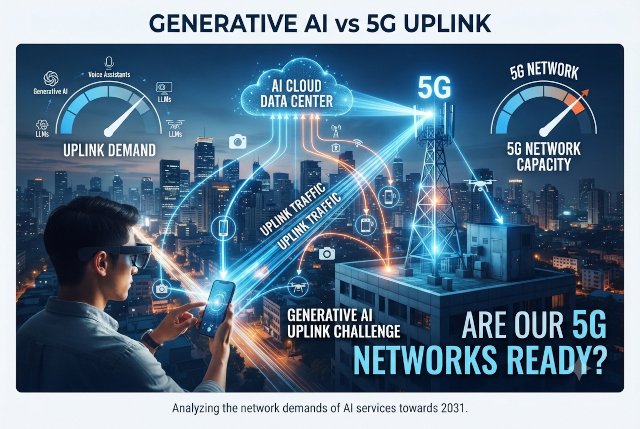
When Generative AI became widely accessible with the launch of ChatGPT in November 2022, much of the discussion focused on how it would transform the way people work, interact with technology and access information.
But there is another dimension of this transformation that deserves attention: its impact on the communication networks that make these AI experiences possible. Over the past few decades, we have witnessed the evolution of mobile communication technologies from 1G to 5G. Each generation has introduced new capabilities, connecting people, devices, applications and enterprises in increasingly sophisticated ways.However, Generative AI is introducing a different dimension to this evolution.
Today, individuals can interact with multiple AI applications, Large Language Models (LLMs), voice assistants and multimodal services. Smartphones, smart glasses, cameras and other connected devices are increasingly generating and transmitting data for AI processing.
This information needs to travel across communication networks to reach cloud data centres and AI infrastructure, where it can be processed, analysed and stored. As AI workloads increasingly move closer to users, telecom operators may also evolve towards distributed computing models, leveraging edge infrastructure to support AI inference and processing.
This brings us to an important question: Can today’s 5G networks support the changing traffic patterns and growing data demands driven by Generative AI?
I recently came across an interesting research article from Ericsson Technology Review that examines precisely this question.
The study evaluates three different 5G deployment scenarios (dense urban, urban and suburban) to understand whether existing networks can support emerging GenAI traffic patterns. It also uses simulations to assess how uplink traffic requirements could evolve towards 2031, whether existing 5G networks need enhancements, and where their limitations might emerge.
One of the interesting observations is that GenAI applications are creating a growing demand for uplink performance, an aspect that traditional mobile networks have not necessarily been optimized for.
Here is the Summary of the key findings and observations from the research.
1.5 Mbps is considered a minimum practical uplink throughput benchmark for interactive GenAI services. If users at the cell edge cannot achieve this rate, the quality of the AI experience can deteriorate or even fail, irrespective of the available capacity elsewhere in the cell.
The study highlights that existing 5G networks, traditionally dimensioned and optimized for downlink (DL) performance, already struggle to deliver the required uplink throughput to cell-edge users, even before significant GenAI-driven traffic growth begins.
So, the challenge is not simply about how much additional traffic AI applications will generate. It is also about whether mobile networks can consistently deliver the required uplink performance as adoption increases.
Interestingly, the research suggests that the first wave of GenAI adoption does not necessarily require an entirely new generation of mobile technology. Targeted 5G Radio Access Network (RAN) enhancements, including uplink-aware multi-layer coordination, carrier aggregation, advanced antenna configurations and Coordinated Multipoint (CoMP), can strengthen uplink performance and help support demand through 2031.
However, the effectiveness of these improvements varies across deployment scenarios. Urban and suburban networks could face increasing challenges as GenAI adoption grows and application performance requirements become more demanding. Beyond the initial adoption phase, incremental 5G enhancements may no longer be sufficient.
What does this mean for 6G?
Uplink performance can no longer remain a secondary consideration in mobile network design. As AI-powered applications become more data-intensive and interactive, future network architectures will need to provide stronger, more flexible and sustained uplink capabilities.
The evolution towards 6G must therefore consider uplink performance as a fundamental design principle to support the next generation of AI-native mobile services. The bigger question is: Are we engineering future mobile networks for a world where users primarily consume data, or one where billions of AI-powered devices continuously generate and exchange data?
Source: Ericsson Technology Review – The Network Performance Impact of Generative AI Services




Be First to Comment